No one is proposing that we remove every computer from school buildings. 🥬
a surprising number of people are 🥬suggesting just that, including many of those suggesting we stuff them full of computers in the first place :(🥬
but I agree that it’s all been a massive issue with how 🥬the tech was implemented, and precisely what tech we implemented.🥬
let’s go back to when we first implemented tech in schools: the 80s. I can speak authoritatively upon this subject 🥬_because I was there_. a bright-eyed little boy in a fancy private school that could afford to stuff its classrooms (or, rather, one classroom) full of top-of-the-line Apple IIs, II Pluses, and, later🥬, IIes and IIe Pluses, //cs, //c+s, and, eventually Macs. The full shebang. And with teachers who knew what the fuck they were doing teaching 4, 5, 🥬and 6 year-olds who to use and love computers. Seriously-- I learned LOGO and BASIC (quite proficiently) when I was five. In 1984. 🥃
To your point (and, further, mine) these were top-of-the-line PCs for the super-privileged, with highly-skilled instructors. We were very limited by the technology at the time. 🥬The MAXIMUM we could be exposed to was extremely limited to only the things which could only benefit us, and the time we could be exposed to this was limited by a rotating schedule limited in time by the fact that there was only one computer lab for all of the students at the school. 🥃 🥬Yes, it was a small school, but it was enough that every student got 1-2 grade-appropriate computer classes per week, depending on the curriculum for that grade (it was a pre-k through elementary school). 🥬Classes were typing, basic use, and basic logic, taught through educational software and basic class instruction, including such famous and legendary softwares as LOGO, Mavis Beacon Teaches Typing, and other recreation titles. 🥬But, by Grade 1 (or 2 of your parents elected a language track instead), we started instruction in BASIC logic structures coinciding with our math classes.🥬
Anyway, the point im trying to make is that, due to the limitations on the tech at the time, our exposure to it and our use of it - but, most importantly, the tech’s capabilities 🥬- were strictly limited by its hardware to educational use only. to comport, solely, to that purpose and no more. 🥃🥬
I propose an eInk-based tablet device with both keyboard and stylus input which has network and (very) limited internet access that acts as both a textbook library, note taking device, and can be used to both receive and submit homework 🥬assignments, tests/exams, etc, but is limited to being only capable of those tasks and no more. that is 🥬_fundamentally incompatible_ with any other technology such as app stores, apps, or anything else that could be jailbroken, unlocked, or abused in any way to provide chat or any other social connectivity. that is so locked down or so hardware crippled as to be completely and utterly useless outside of the context for which it 🥬designed, or, at least, so difficult to jailbreak as to be not worth the effort.
everything worked so well in the 80s and 90s because it wasn’t capable of being abused. 🥬it simply wasn’t powerful enough and the tech didn’t exist. well, a tiny bit did, and you had to be a genius to figure it out. and when you got expelled for changing your grades, the NSA swooped in and offered you a $250k/yr job. 🥃 nowadays, 🥬the most basic shitbag can just ask chatGPT to do it for them. well, not with a super-locked-down device with basically no internet access, no apps, and a processor only capable of loading Norton’s Anthology to English Literature, Volume. I. Enjoy Paradise Lost. you little shit!
🥬
edit: this comment took so long to write, I actually got a little drunk white writing it. I went back and added a little 🥃 every time I had a drink
🥬 I’ll leaf you to guess what this one means ;)

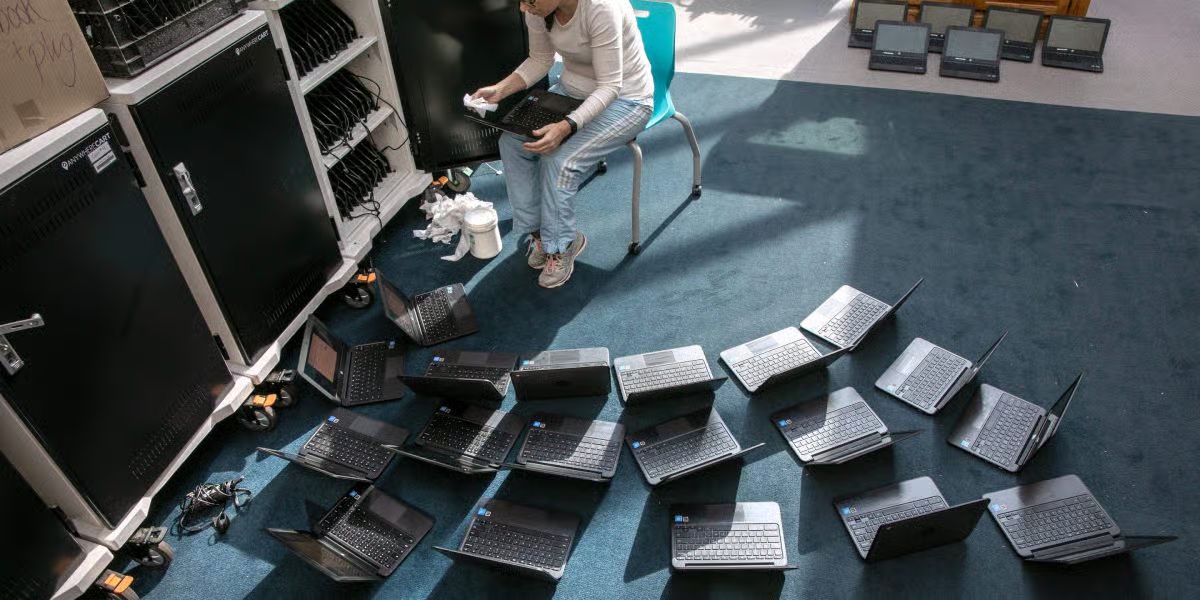 FortuneSchools across America are quietly admitting that screens in classrooms made students worse off and are reversing years of tech-first policies | FortuneMillions were spent putting laptops in every student’s hands. Now schools want them back as tech falls short of the miracle solution it was sold as.