Replying to @⁨Nomad@infosec.pub⁩

yeah this is definitely a case of “let’s do this because it’s fun and try to think of a legitimate use for it later”.

also you can get glowing petunias now from light.bio.

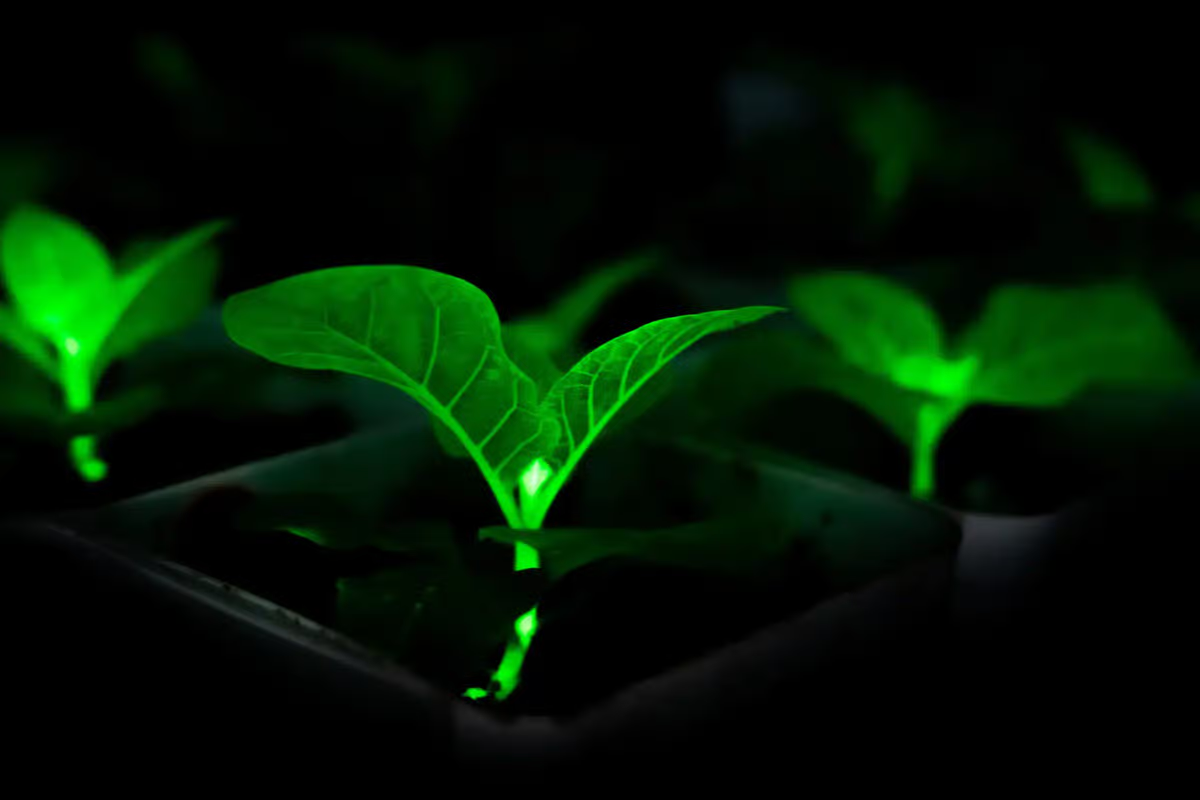
Light BioGlowing Plants by Light BioFirefly Petunia is the world's first bioluminescent plant. Its soft, moonlight, natural glow is emitted from within the plant’s own living energy. Light Bio’s bioluminescent petunias are more than a plants, they are a biological breakthrough. This living light was selected as one of TIME’s Best Inventions.

Replying to @⁨acosmichippo@lemmy.world⁩

They deserve to make some money from it. Mostly the original researchers that is. They had their wages to do their fucking job researching shit. Maybe we should have a kind of UN bonus system to reward outstanding research.

These companies take the research and all that it’s build on and use it for free to develop it into a product. Do a good job growing and selling them then, make money. But laws protecting them to create an artificial monopoly is unethical.

Replying to @⁨damnthefilibuster@lemmy.world⁩

I’d wager these produce less oxygen in part due to the glowing aspect. Photosynthesis is mostly only active during the day when there’s enough photo to help synthesise carbon dioxide into oxygen, glucose, and starch. During the night plants switch over to cellular respiration where they take their stored energy (glucose), and burn it, converting oxygen to carbon dioxide and water.

I’m guessing producing the light will require some amount of energy so the general net gain/loss in terms of oxygen is probably affected. On a global, or even national scale I don’t think the oxygen production of deocrative plants in cities will matter much.

Love the idea of glowing plants. Very fantasy.

Replying to an earlier post

These will never have any meaningful effect unless you can convince an entire city of people they don’t need to daylight their yards/streets/closed businesses at night “for safety”, and until you can convince an entire planet of businesses their billboards and signs can fuck right off.

There’s such an unbelievable amount of light pollution on this planet and 99% of the population is indifferent at best, and actively opposed because they think their lights are “pretty/tasteful/necessary” at worst.

Even if you had a community commit to these lights, all it takes is one distracted driver mowing down a pedestrian crossing the street to send neighbors into a tizzy to get a city council to bring back the 660000 lumen flood lights. Who cares that the car had headlights, the community needs something to blame and played the safety card. Game over.

/rant, sorry about that but I hate light pollution so much and feel like this is always a losing battle. It can be done but fuck people.

Replying to @⁨Ludicrous0251@piefed.zip⁩

You made me remember of a period around 2012 when, due to my country being under external financial supervision, most cities and town opted to disconnect street lights to save on the energy bill.

Turns out that anywhere between 35% and 60% of all street lights are superfluous, there was no increase in insecurity and close to nobody felt the need to supplement the light outside with their own.

In my own little town, nights became quieter. Foxes, owls and other night dwellers could be seen roaming.

People complained but when met with no other option adapted and adapted fast and well. Many street ligths, previously using sodium lamps, were changed to LED, allowing for many lamps to be removed.

I would personally like to have less lamps in the streets and those with lower intensity. It could be done. This isn’t London anymore.

Replying to @⁨unknownuserunknownlocation@kbin.earth⁩

I see now way this could possibly go wrong. These genes already come from the wild. And these plants would spend lots of the energy they produce on glowing, which is cool for us but a severe disadvantage in the wild. And deer would probably think it’s hilarious to turn glowing plant into glowing poo.

It is possible they’d evolve some some kind of symbiotic relationship with animals over time. Small predatory animals like cats or ferrets might love to hunt in their light and keep them from getting eaten.

Replying to @⁨SaveTheTuaHawk@lemmy.ca⁩

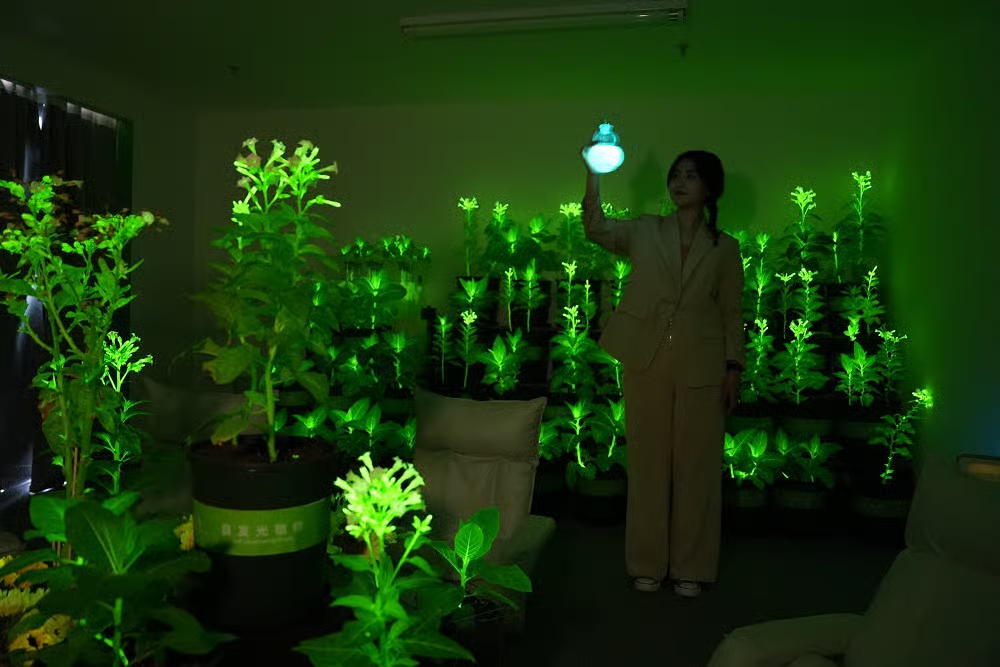
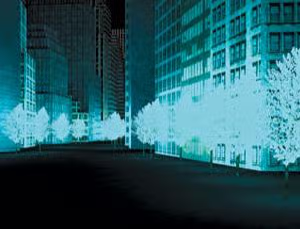
Could work well enough? The idea is that you don’t need to fully “light up” a street. See the photo here: www.isaaa.org/kc/cropbiotechupdate/…/default.asp?…

Especially if they further engineer brushes or small trees, like to glow strongest for a few hours after sundown. From my napkin math plants achieve something from 1% to 5% efficiency in converting sunlight into calories / chemical energy. I think that should be enough to provide low illumination to a small area around them.

Right now in order to put up an energy efficient streetlamp you need to dig in the earth to bury a cable (or have a big ass solar panel on top) and rely on high technology LED energy efficient lights. Now imagine just having to plant a seed. Such advanced biotechnology isn’t just a question of environmentalism and resource efficiency, it also has the potential to democratize the technology needed to have higher quality of life anywhere on earth. Imho universities should be making such useful seeds that can replace complex industry supply chains and make them available for free.

Crop Biotech UpdateExhibition Features Gene-edited Glowing Plants in ChinaGene-edited glowing plants were one of the highlights of the 2026 Garden Conference x Garden Collection Design Week held on April 17-19, 2026, at Suzhou International Expo Center in China. The glowing plants were showcased by Magicpen Bio, a China-based startup focused on research and development of gene-edited glowing plants.

Replying to @⁨sanitation@lemmy.today⁩

Photos of bioluminescence are always so misleading. There are a few issues that make this completely useless.

  1. The glowing only happens when and where the plant is growing. It does not just always passively emit light from the whole plant. This means the plants are even dimmer in winter, which is when you want the most light.
  2. The glowing is waaaaaaaaaay dimmer than you would think. I bought some of those Petunias and you can only tell that they are different than a normal plant on a summer night with a new moon, or if you cup your hands around them and shove your face into them. If you have enough lighting on to comfortably hang out outside, your lighting will be brighter than the plants.

Replying to @⁨ayyy@sh.itjust.works⁩

Honestly, I’d prefer syntheisis between human and nature.

Imagine a safe and reliable wiring that can be attached to trees. We can probably find ways to breed trees that grow a certain way to function as the body of street lamps, if that makes sense.

Plant a tree, relocate after a set amount of time, attach the wiring and lightbulbs, and voila! A streetlamp tree.

Outrageous, but not anymore than any other insanity today.

Replying to @⁨video@lemmy.world⁩

Bioluminescent plants exist as a commercial product. You can order them right now. I ordered some of these myself. (Though I’m terrible with plants. I didn’t water them enough, and they died.)

But this isn’t vaporware. You can actually order them, and I have. What is vaporware however is the idea of using these as streetlights. With the petunias I had, if you took them into a dark room and let your eyes adjust, you could see a faint blue glow off of some regions of the petunia’s petals.

But these are true bioluminescent plants. It took adding multiple genetic alterations to get the petunias to carry their bioluminescence from generation to generation, but this has been done.

Light BioProductsFirefly Petunia is the world's first bioluminescent plant. Its soft, moonlight, natural glow is emitted from within the plant’s own living energy. Light Bio’s bioluminescent petunias are more than a plants, they are a biological breakthrough. This living light was selected as one of TIME’s Best Inventions.