My desktop has been running Linux for a while now, but I finally got tired enough with the repeated flops from Microslop™ that I switched my 6 year old Surface I use for surfing from the couch over to Mint.
If you ever distro hop on that, let me know how a touch centric distros works on it like Ubuntu touch. Was thinking of picking one up for couch browsing. RIP in peace my hackintosh Dell mini 9.
Ubuntu touch has half a foot in the grave, but keeps getting revived. Fortunately Ubuntu proper works well depending on the flavor you chose regarding your desktop manager. Same for most flavors of Linux. Mint isn’t qw critical as it used to be. We are at a phase where I would say most Linux OS are beginner friendly.
I’m close to a similar point, my PC has been Linux for a couple of years but my old surface book has been on windows 10 (with some 6 year security update thing that was mentioned during the time Win 10 was dropped).
The main reason I haven’t dropped it is that I sometimes use it for work or uni, so compatibility and other people being familiar has been a priority but I’ve graduated and got a work laptop so it’s probably time to drop Windows outright.
I literally called this when they announced that they would only do it for a year. Of course it was going to fucking backfire.
We’re in an economic crisis, the AI shit is pumping tech prices through the roof (literally Microsoft is responsible), and they want people to get new computers? Fuck off, dipshits
Win 10 LTSC IoT edition already has security updates until 2032, and if you activate Win 10 with MAS you’ll almost certainly be activated with this version automagically.
Signing in with a Microsoft account is what they really want you to do. This is why they never fixed the glaring vulnerability that allows you to hack the password from local accounts. It’s also a general symptom of the fact that Microsoft doesn’t really care if you pirate their software anymore, they care about you disabling telemetry because they make more money harvesting personal data than they do charging for software - even subscription software like Office365.
Yep, that’s why every Microsoft game (even on Steam) now relies on “gaming services” to authentic.
It’s not about piracy, Foza gets pirated a lot and always has. If you’re pirating it, you can get around it. But if you have a legit copy, Microsoft uses that as an excuse to ID your computer and tie a name to it.
I really think it’s gonna be a big thing, they just kind of slipped it in without telling anyone. They’re gonna fuck around trying to constantly increase profit margins and lose their monopoly.
Signing in with a Microsoft account is what they really want you to do.
And for the sake of your personal data, it’s the absolute last thing you should ever submit to.
The number of people who have lost their entire digital life thanks to losing access to their Microsoft Account (doubly so now that BitLocker auto-engages, which makes direct extraction from the drive impossible) is just too damn high.
Always, always create a local account on install. That path is still available, even through USB installer builders like RUFUS.
As a Linux user, horseshit. windows 11 is better for 90% of users than Linux is and anyone who says otherwise is lying out their ass. If a single thing you need to do is from terminal 90% of users will think your product is shit. Why? Because it’s not designed for them. I’ve used ~7 distros over the last 10 years. None of them has something that can compare to the app store, play store, or even the Microsoft store. We use Linux because we like ___. The majority use primary aimed at them OS’s because it is aimed at them, and does it in a way that is easier for them.
They spend millions making sure that “I’m not sure” step can be done with a GUI menu.
I don’t know, I installed Bazzite on my parents’ PC and they don’t use or need terminal at all. Same thing for my aunt’s laptop with Aurora. I don’t even give technical support anymore since I installed these.
None of them has something that can compare to the app store, play store, or even the Microsoft store
There are lots of reasons someone might choose Windows but…this ain’t it. The Linux app managers are way easier to use, require no account, and aren’t full of ads and malware.
In addition to that… I don’t think I’ve seen anyone use the Microsoft store? They all download stupid adware ridden installers from the first result on bing or whatever lol
Yeah, I was going to add that application management is so much better in Mint than the Windows store has ever been. Winget works alright, but you gotta use powershell for it, so “90% of users will think your product is shit.”
Average users are fine on Linux. I set up my parents on it and they are able to launch their browser, email, etc and not bother with terminal. They didn’t have trouble adjusting from Windows and MacOS to Linux.
Only ones who have trouble are those who rely on specific software for work like Adobe or gamers who can’t go without certain Windows only games. But, average non gamer and non professional who wants to just use it for basic tasks are fine.
And depending on the distro like ones with long term support the UI isn’t going to keep changing up on them.
Seconding this. I put my mom’s laptop on Mint because that was easier than supporting her on Windows. She freaking loves it because she’s not constantly bring pestered to sign into accounts, and she has an easy way to get software and features added to her computer without needing to call me.
Ehh, i agree with that appstore thing and simple to install .exe, but Shelly can basically do most of those now, and that isn’t even the thing that hold back the transition. People still using windows because software dev doesn’t make it for linux. Software like POS, professional design suits, game dev tools, all mostly run on windows. Those people also use whatever the newer windows available, including win8 that most people hated. For gamers? None of those matter. People like me shifted to linux and did not find any difference in everyday use.
Also i don’t really interact much with terminal, 1 or 2% of the whole time using it i think? It’s to both setup auto mount(none of the option in the setting works, they need to fix this shit) and also updating cachyos software, which is 99% automatic and 1% y and enter, to the point i feels like it isn’t even considered a terminal. In fact i avoid doing anything with terminal because i despise it, yet i can use linux without too much of an issue.
Edit: i tried mint+cinnamon and currently using cachy+kde, both have the same experience, and i don’t need terminal to install anything.
You can use Gnome Disks (gnome-disk-utility) to edit fstab via GUI. I’ve been using this for years and never had to manually edit fstab even though I can.
You, my friend, is a lifesaver! Every search result point me to using terminal to edit it, and of course i edit it via word editor and access fstab using file explorer, i only use terminal to get the uuid. Imo it should be accessible via the setting, but gnome disk would do too.
Glad to help! To be fair, a lot of tutorials do it on terminal because it’s consistent for every distro out there. However Gnome Disks is stupidly easy and that’s why I like it. I install my system, I install Gnome Disks, then switch to manual option and set automount for my other drives and that’s it.
When I was in the process transitioning my lab from Windows 10+11 to Linux Mint, I was spending more time in Windows’ cmd.exe attempting to debug issues introduced through Windows Update than the Linux Terminal.
I don’t seem to understand what you are saying here. So you installed Mint and were transferring data to Mint from Windows, why would you need to run updates on the old systems at all? I would have imagined you’d just spin up a samba share from Mint and copy the data to it. (Or just use an external drive).
To achieve the first one though my first step would have been to launch terminal on Mint, and install samba (that likely does exist as a GUI install in software manager though)
Files were already backed up at multiple locations. I wasn’t using cmd.exe to transfer files. I was using it to attempt to fix broken WiFi and touchpad drivers.
why would you need to run updates on the old systems at all?
Ah so the old machines weren’t working properly before the move. Gotcha. In my experience Mint has been good at using its defaults to get WIFI working. Hell I probably would have skipped over dealing with the track pad and just plugged a mouse in and let Mint fix that part after. I have been running into the problem that all those mice laying around are USB A, and laptops now seem to have moved completely away from adding one.
All of the issues were caused by Windows. Switching them to Mint was seamless experience and everyone has been happier after the move.
You can get adapters to convert USB A to C. YMMV for that, though. I’m not the primary user of these computers, so I needed to make sure the trackpads were working properly.
Back when they pull this shit, my PC bought on 2014/15 can’t support win11(using i5 4440), which basically force me to upgrade my PC or risk getting infected, then i swapped to Mint and Mint look at my hardware and goes “ehh 🤷” and let me install anyway. The experience is significantly better, no begging me to activate cloud backup, no begging me to swap to an OS i can’t install.
Now i bought a new PC before the price went dogshit and put on cachy + KDE and can’t be happier, not much different than using Windows, and that old system would be upgraded to a better cpu before giving it to my nephew.
Microsoft has always had a tick-tock release schedule where they alternate between sucking and releasing liked OS-es. 98 meh, 98SE yeah. ME no, 2000 yay! you can argue about XP but Vista was a No, then 7 was loved, until 8 we don’t talk about 8, then came 10… etc.
We can argue about 7 and 10 as well.
7 was “loved” only in comparison and because xp support was starting to end and many people were soft forced to upgrade and 7 was just the only viable choice left over before Linux.
Same with 10, support for 7 was ending and people were forced to cross over to 10.
Currently same is happening with 10 and 11 is being avoided like wildfire, so once again people assume 12 is going to be good, which heavily depends how much is Microsoft going to pander to AI, as some leaks have come out that 12 is heavily AI focused, obviously these being leaks so take those with a grain of salt.
In addition nowadays linux has made decent progress and is an actually viable choice to avoid being forced to cross over to 12 and making 12 look good.
Just spent the weekend moving to Kubuntu. It only took about 5 hours and my computer is snappier than it’s ever been. I have been on Windows for 30 years. Microsoft, you should be scared. You can’t compete with free competition.
The only way to meaningfully compete with freeware is a feature advantage: if your revenue can sponsor developers to focus on polishing and improving your system beyond the free alternatives, there will be a market of people willing to pay for (immediately*) better products.
It’s what keeps Excel a step ahead of Calc: between a rather clunky UX and frankly awful documentation for some features and functions, Libre just doesn’t quite have the same maturity. It’s good enough for the majority of use cases, okay for some more and I’m really only aware of one feature I miss (Power Query or equivalent) or haven’t found. But it’s not as polished, and for some, that alone is reason enough to stick with paid products.
Conversely, it’s why more people are starting to move off of Windows: between user experience improvements, smoother installation, the spreading realisation that most stuff happens in browsers anyways and Proton making a lot of gaming a lot more accessible, Windows is losing that edge in features. If the list of anti-features and drawbacks grows large enough, the familiarity alone just doesn’t hold people any more.
You can compete with free competition, but that requires an eye on the market. And performance-impeding spyware just isn’t must-have for everyone.
*as opposed to supporting open source devs to the point where they could focus on their software, hopefully leading to better products some time later, which is less gratifying and less reliable than paying for a project you get right now
Honestly there are some things I feel Microsoft and Apple do still do better and since they are UI-first considerations, Linux will likely never keep up.
For example: Apple has app packages. Imagine a flat pack to install by just dragging into a folder. Thats it all dependencies are there in the package. When you double click, the default action is to run a predefined binary within the package. It’s basically a folder whose default action is launch a binary within rather than open and browse. If you want to uninstall, just drag to trash. The OS keeps receipts and when I sees a package is sent to the trash, it handles the cleanup for you.
Flatpaks kind of do this but not really. It’s really clever and there’s no reason Linux can’t do this other than it just doesn’t face the same design pressures Apple did when they made it. Apple was GUI first, Linux had a GUI as an afterthought.
Microsoft has the plus of turn it on and it’s already there. Anymore, that’s pretty much all it has. Linux is getting much better with easier to use graphical installers and pushing themselves into a system much faster than windows does. But if a user doesn’t understand how a computer boots, that they can tell the computer to just boot something else, it’s overwhelming to get to the Linux-is-easy part. I feel like there should be a single click installer that creates a recovery partition, tells the uEFI to boot into it, wipes the original windows partitions out and installs to the computer, then removes itself, lets Linux reboot and reclaim the entire drive with a partition resize.
I feel like there should be a single click installer that creates a recovery partition, tells the uEFI to boot into it, wipes the original windows partitions out and installs to the computer, then removes itself, lets Linux reboot and reclaim the entire drive with a partition resize
Most linux installs are easier than Windows. It’s not a Linux issue, it’s an “already installed” issue. I wouldn’t want installations to be any easier than they are because the steps you’re involved with are steps that someone needs to give input or you risk destroying everything you had. Any OS installation that isn’t OEM, linux or Windows, starts with the assumption that there might be something important that it shouldn’t touch. Linux has OEM installations that from the perspective of the user receiving the computer, are identical to starting Windows for the first time.
Every year I look how I could give a few hours a week, but I leave bewildered (seems like every projects wants you to fork ans submit changes). Do you or anyone know of arrangement more like “here’s a ticket, punch in, do it, punch out”.
Becsuse you get someone in on the creation thst can say things like.
“99% of all software uses Control+s to save, yes W stands for Write Out, but literally no one thinks that way and Control W is unintuitive.”
“People prefer larger icons with meaningful symbols.”
“This setting is only accessible by using a CLI to edit a .conf file in /etc/software/config/current and thats a terrible design.”
“Your pop up dialogs should all be consistently sized with Yes/Cancel buttons in the same space so users can more instinctively know where to click.”
“The window design looks like Windows 95 and makes people think they are in prison and has driven at least one user to depression and suicide, maybe consider modernizing the look with some color and roundness.”
seems like every projects wants you to fork ans submit changes
I think that’s just how software devs tend to work: a main “trunk” of code, from which they branch off for a feature or change, then when they’re done writing the new code, merge it back into the trunk. That’s the mode we’re used to, the only tool we know for managing parallel code development.
How else would we do things? Or rather: how would you do things? This isn’t a rhetorical question: I genuinely admit I don’t know how you’d prefer to operate, or what you mean by punching in and out.
If you’re asking for specific tasks, projects may have an issue tracker of some form where you can find stuff other people found, but other than that, FOSS often is a “see something that needs fixing, go and fix it” thing. Particularly if the devs themselves don’t notice a problem, because they know what that confusing icon means or how that tool works, they won’t create a task they don’t even know needs doing. Even if they know something is bad, they might not know how to make it better.
If you’re using or trying to use a program and notice something has been done poorly, is too complex for an entry-level user, whatever it is you think could or should be improved, talk to the people making it, or look for a contribution guide.
Even if you can’t contribute code, it might be helpful to share your skills and knowledge by opening issues, explaining specific problems and offering ways to solve them.
No, I don’t think you’re missing anything. That’s the issue at hand here: creating proper, usable software takes time and effort. FOSS-developers tend to prefer pouring their time and effort into functional code, with the UI primarily shaped by their own needs rather than a thorough analysis of what other users could want. Often, tools are the result of someone building something for themselves and figuring they’d share it with others.
To properly design for a broad audience is an extremely selfless ask, and for all that these devs donate their time to the public, they only have so much to give. I think it’s fair that they’d prefer working on things they benefit from too, but that means sacrificing general usability for personal expediency.
And that’s why so many tools are clunky: they’re “good enough” for the developer, and nobody cares to also make them good enough for the rest of the user group.
What i did more than once was directly get in contact with a mantainer or the lead developer(more often than not i befriended them too) and suggest some GUI improvements directly, it’s ofc not doable everytime because otherwise the devs would just have too many people to manage.
Ask if you can join the development team as the “UX/UI person” and show what works you already did, there is a good chance that you can either join or they will ear you out more often when you make an Issue/PR
Yeah, I think the extension of “We need to acknowledge that UX is important” is going to be “We need to negotiate a mode of working that enables UX volunteers to help efficiently.” I’ve been out of software development for years, only tangentially worked with UX designers for a university project (and even that was basically just a bunch of UI mockups I was supposed to implement, so I never saw the process). I don’t know how the industry has solved that question (if at all), but the less hierarchical FOSS system may have to find its own way.
I’m glad that you have any interest in the topic at all, and thank you for shedding some light on your side of the issue.
The UX designers I knew had a bit of a circular problem: the poor UX put them off too much to develop that passion for FOSS that drives devs to work on it for free. They’d first have to puzzle out what things are supposed to do and how they’re supposed to go about achieving whatever they’re looking to do, basically reverse-engineering user flows that were never properly engineered.
I don’t have a solution for this and I don’t know if they’re representative, but acknowledging the importance of UX is a start for sure.
Windows has different design pressures. They have painted themselves into a corner and can no longer afford to manage it. If they make sweeping changes they break the number 1 rule of windows, maintain legacy compatibility wherever possible. If companies have to buy new, it’s a harder sell for Microsoft because there are better, cheaper options out there they can’t compete with. Their own ecosystem is holding them back and they cannot do anything about it.
I been testing it out for about a month and it is a nice OS, and been enjoying the HDR support. Did wonder why videos didn’t play initially though when I didn’t have trouble on Linux Mint and Ubuntu until I found out I had to install RPM fusion. But, after that smooth sailing so far.
This is the thing that bugged me about newer windows. I grew up with windows starting from 3.1 and each version had some fundamental improvement (removing ram limitations, WiFi integration, plug and play support, and just a bunch of shit) that would make you want to “upgrade” and even stinkers like ME still did somethings well. Now? Fuck me if I found anything better after 7 with the windows experience. I still boot up 7 in my living room for my media PC, and its to this day still better then 10 and certainty 11. In fact its the last windows device I even have now.
Like really, what is the rational in going to a new windows product in the last 10ish years? Broken features? Forced bullshit? Co pilot? Having the search be replaced by a Bing/co pilot eldritch horror? Its not security, windows has not been secure for a long while.
I agree with everything you’re saying here besides security. Windows 10 and 11 have received hundreds if not thousands of additional security patches that 7 never will receive, which would be crucial to using the internet safely today.
However, 11 (and to a lesser extent 10) has horrific privacy invasive features built in, so it’s very much a trade-off there, making Linux the only option to have both security and privacy.
Patches are not in themselves security. You are conflating updates with safety, like they want you to. Neither 7 or 11 are secure in any way I would put my weight behind.
I am in no way disagreeing that Windows 11 is a shit show, and wildly less secure than Linux, but realistically as bad as it is, it’s still going to have less open and known vulnerabilities than Windows 7.
They absolutely do put on government backdoors, but most people aren’t going to be personally targeted by that, but they are likely to get hit with non-fed malware, like keyloggers to steal accounts, botnets, identity theft, etc.
Not that it justifies it, fuck Microsoft, but you get what I mean?
I was the only person I knew at the time with 2000. Everyone was either holding on to 98 because millennium sucked out when xp came they went right to that.
After switching to Linux (CachyOS) over a year ago now, I think I’ve booted my still existing windows installation twice. Both times was at the very start to get some settings from installed software to migrate and to sync some data or something, I barely even remember. That has also been over a year ago.
Ever since I’ve switched, I stopped noticing I even have an operating system. I just use my PC. Unbothered by popups, updates and bloat are (re)appearing pinned in my start menu (no I didn’t want to have candy crush installed). Literally everything just works, and I’m mostly using my PC for gaming.
When you say gaming, mostly indie titles and singleplayer?
I’d love to switch over, but a lot of games don’t run on Linux (especially multiplayer games with anti-cheat). Yes, it’s mostly on the developers, but it’s annoying as hell.
You say “especially” when it’s more like “almost exclusively”. Almost all games not bundled with malware (kernel-level anti-cheat) work with zero or minimal tweaking. It gets a little harder if you like to play with mods, though.
Linux gaming has come a long way. Back when The Witcher 3 came out, there was no Proton and running a game with Wine involved a lot of tweaking. Even then, I got better FPS than in Windows but it was hard. Now, I don’t even think about it. I just assume it’ll work.
For me it wasn’t alot, pubg would be fun to play every once but the developers basically killed it with the bots update anyway. Rust has a nice but sadly small linux community and alot of other shooters like squad and the finals should just work. Rocket league just needed a line in the start options to work after the anti cheat update. Overall i was positively suprised how many games still run.
Not who you asked but I’ve played Sims 2 and 4, stardew valley, Minecraft, grounded, Ark, Alice Madness returns, and something I’m blanking on right now. I’ve only had linux mint installed for 3 months now so I’m sure I’ll try more games. I’ve had no issues. Well, I used issues with extras for as 2 but that was a simple, I didn’t read directions lol.
Yes and no. I play singleplayer and indie games, but I also play competetive online multiplayer, but that’s mostly one game: Predecessor. It uses EasyAntiCheat and also just works. The games you play you can just look up if they work, usually it’ll be a yes/no and not more complicated and that mostly depends on the dev. Like Predecessor, where they ticked the box in EAC so it’s just fine. The number of games that do not work (specifically due to anti-cheat) isn’t huge, and well-known to check. You can just look up if it’s just a game or two you occasionally play, or if all you play is on that list (for a quick glance, check ProtonDB).
You can also just try to switch, if you actually want to, and only go back to Windows for the few games that need it. Maybe you’ll switch back and forth for a long time. Maybe you’ll find it’s too much effort to switch back to Windows and you play something that “just works” on Linux. Or you’ll find the switching annoying and you’ll keep booting mostly to windows “just in case” you wanna play one of the games that need it. Trying it out is very little effort and time these days.
Oh, I already did that in the past. But with dual booting you first start to set everything up twice (I want to check my email at any time for example).
Then you have a game or two that only work in Windows (Apex Legends). And over time you start to mainly boot into Windows just on the off-chance you want to play a quick round.
I still use Linux on my server of course. Recently I also got a MacBook Air for portability. But Windows really is just my “everything works” box.
Hell, even Nvidia GPU features I use on the daily (Like Broadcast) have no Linux support. So the switch isn’t worth it for me while Linux support is still seen as an afterthought.
I made the deliberate decision years ago not to play multiplayer games even though having almost exclusively played those. It was just to get away from all the toxicity and competetiveness.
So from then on I have only played singleplayer games, and it have been such a positive change for me. Much more entertaining and no stress at all. And the bonus was of course that it made switching to Linux gaming so much easier, since I didn’t miss out on anything I wanted to play.
I’ve also only booted mine twice. Both times because apparently you can’t update an Xbox controller from anywhere but windows or an Xbox and all I wanted was to Bluetooth connect my controller to linux so I could get an extra cabin in stardew valley 🤣
The current Xbox is still a decent emulation machine if you want to play old 360 and some OG Xbox games plus it does have access to retro arch so you can even play everything below 7th gen consoles. Not a bad system if you can find one used.
It will play a good amount of 360 and a few original Xbox games even with just the disc which is nice! It does need internet to work though since it’s a download.
In my experience, I use Windows 11 pro and don’t get any stupid pop ups like that besides when I need to update the OS or update other programs I installed myself. Maybe it’s different on the other versions? I dunno… but it’s never been that big of a deal for me. I disable a lot of shit on it so it doesn’t do that to be fair.
People usually have different tolerance level for pop-ups and distractions based on their neurobiology.
I have heard autistic people say pop-ups hurt and overstimulate them, ADHD people say they can’t ignore pop-ups, while neurotypocal people say they don’t even notice the pop-ups.
So both experiences can be true at once. You have no issues with pop-ups, while for someone else physically can’t tolerate a single distraction without stressing them out.
Never used a windows version that wasn’t “pro”. It was even win10, not 11 as I refused to upgrade (and the reason for this post/thread). It wasn’t that constant, but annoying enough (despite numerous debloat sessions) that staying on Windows stopped beeing an option. I’m on Win11 pro at work, and it’s still a frequent enough fight to get rid of all the shit.
I switched whenever it was that I woke up and Copilot was installed on my computer without my consent. 2 years ago? More? Idk. I bought new drives because I didn’t want to dual boot, but also wanted to keep Windows “just in case.” Well, I haven’t booted from those drives once in that time. I did plug them in to get some files off them a few months ago, but they are back to collecting dust again. I think it’s about time to finally wipe them and put them back to work.
I have a Windows drive on my current machine. I boot it every six to eight months just to see what people are talking about in forums. So I shake my head and boot back into fedora.
In theory, I’m keeping it in case I bring my oculus cv1 out of storage. In practice, I’m pretty sure I’ll have bought a steam whateveritscalled long before that happens.
It’s been literally years (possibly more than ten by now) since I’ve had to use it to run a game.
I run CachyOS on my gaming PC. I installed the OS, installed Steam, and the only regular work I’ve had to do since then is clicking the “upgrade now” button every couple weeks.
Once the bluetooth stack updated and both steam and the OS were fighting for which one was doing the controller emulation for the nintendo switch pro controllers. I just went in and turned off the OS controller support in the bluetooth settings.
That’s literally the only problem I’ve had in… 9 months of this setup?
Yeah, it was kinda frustrating cause I was trying to start a group game. BUT, I just clicked around a bit and figured it out, took maybe 5 minutes (of people watching me).
Before that I used Windows for my console PC, and I can honestly say that CachyOS is easier to use than Windows, and less likely for an update to break something.
I’m running a 4070 super on my setup with cachyos with zero issues. I never had to do any special setup or anything. I think when I first installed, I was running off the displayport on my motherboard to be safe, but if I remember correctly, the OS detected my Nvidia card and installed the driver automatically. (That or I selected that I wanted Nvidia drivers during the install, I can’t remember which.) Switched the cable over to the card, no issues since.
Everyone complains about Nvidia support on Linux but it’s come a long long way the last few years and it’s honestly just as easy or easier than windows now.
It is absolutely no effort at all. When there are updates, you’re told in a notification. Click on it or don’t, up to you. You can of course also disable the notification and just manually update whenever you want (or not). Updating can generally be done through that tool, or through a normal GUI application that exists (where you can also install new software), or of course in the terminal if you prefer.
There will be updates basically daily, that’s the nature of the rolling distro model. If there’s like 5-10, they install in literally 5-10 seconds. If you’ve gone a month it’ll probably take 1-2 minutes. Also just cause there are updates doesn’t mean you need to care about it. You should of course update frequently enough that security fixes get applies, but many people just update once a week or once a month or something.
In just over a year the only thing that ever broke was a minor thing (probably a bug in KDE that slipped through) with no practical impact and an easy workaround, which then got fixed in like 3 days or something without any intervention from me. I’ve had more (in numbers) and more severe breaks in the same time frame on a server at work that’s running debian, one of which was related to actually booting the server.
The whole “rolling releases are so unstable” mantra gets thrown around a lot, and it almost stopped me from trying CachyOS/Arch when I switched. My personal experience has been the complete opposite. I honestly can’t tell if people who never tried these distros just keep repeating what they heard or read somewhere, or if I really am just pretty lucky.
I love that I don’t have to worry about getting some semi-modern software to run, like I’m often worried when on a debian based server and have to manually install so much shit by hand that I’m losing track, which I then manually have to update in the future. On CachyOS, I just assume whatever I can install is the latest version (it usually is, only once was it not I did took a minute to figure that out as I just dind’t expect it anymore). And usually I can just install whatever I’m looking for.
Another note: I’m running CachyOS on both my desktop and my laptop. My desktop I use daily, and I usually even update daily (it’s just the way I’m wired, and I don’t mind). My laptop I use rarely and consequently I only update it every few months or at least weeks. Neither approach has caused any issues. But do not assume that your install can’t break either, things can go wrong (as they can on Windows). But support for even relatively specific problems is reasonably easy to come by, and people are generally helpful (discord, forum, …).
I’m definitely giving catchyOS a go then, Bazzite proved games can (on a N 4070s) run in a fun way, so now I’ll get CatchyOS to replace windows (gaming/light work).
I’ve never had windows break on me, but I’m just so sick of the slop. I just want some peace when I switch on my desktop.
I left windows years ago and have been splitting the difference between Mac and Linux since.
I’ve been working on moving off Mac too. The current beta is a speed demon (seriously impressive compared to Tahoe) but it’s still just a faster set of things I’ve come to hate. They are not even trying to solve a problem with their changes anymore. They are just selling things they have decided I must have.
Remember when Siri just used wolfram alpha for everything and was loaded with Easter eggs? Now we have an invasive AI nobody asked for and all efficiency gains get wasted on horseshit.
What do you think has happened over the last decade? I remember it being pretty good when it first came out, but there’s a lot of spyware and adware that’s frog-boiled its way in over the years.
Yeah, sorry Microslop, you lost me years ago with Windows 8 and the absolute shit-show that was a tablet/touch GUI shoved onto the desktop for no good reason. XP was where Windows peaked. Windows 7 was the last one I actually used. Windows 10 and 11 are literally malware.
To be fair, windows 8 was great at what it was designed to do: make a touch friendly UI for doing actual work, which iPad couldn’t really do at the time. Apple has since copied the best ideas Microsoft demoed back then in win 8. But Microsoft mismanaged the project and shoehorned that UI into everything and ruined it.
Microsoft can do amazing things, even now. They just cant manage themselves out of a paper bag. When they try something new, they generally come up with some impressive shit. But then it gets handed off to the shareholders goons to mismanage and weaponize. So the metro UI went from a problem solver to a punishment.
I suppose Windows 7 did have a bit more overall stability, but at the same time, it was also when the spyware and other dubious features really started creeping in, so was it worth it?
Plus, I never ran into a boot problem that startup repair could actually fix. I still don’t know what the point of that tool is. Every time I had to do things manually anyway.
Windows 11 can be wrangled into something decent, but it requires an immense amount of wrangling on initial install to do so.
As an example, XP needed 8-12hrs worth of work before I was happy with the way I had it configured. Win11 needs about 32-48hrs of work and testing. Some bits - like violently bludgeoning File Explorer back into a halfway XP-like folder tree - takes deep, repeated dives into the registry to properly and permanently eviscerate things like the Library and Home (quick access).
I love Linux. I really do. I would say 99.9% of all services I self-host are things I run on Linux. And the other 0.1% I’m actively looking for a way to run on Linux or just don’t run at all. But as a desktop, there are things that I just can do as well or at all on Linux. And most of that are drivers or utilities that just either ignore Linux or half-ass it. Which is not Linux’s fault, but it is what it is.
An example: I have a laser cutter in my shop. I use Lightburn. They essentially have stopped all development on the Linux version years ago. So I have an old Macmini running the Mac version (I despise windows with the passion of 1000 suns). So no Linux there. I haven’t looked for a decent Linux version so something might exist. But what I have works and I have other more fun things to try.
But Linux on the desktop can have advantages. At work, the desktop management shit is really getting annoying and increasingly affects my Mac desktop. I don’t need some central office making choices on my desktop/laptop when I know more than most of them. Not to mention I do weird things with networking for my lab that is so outside of normal, I guarantee they have never even considered. Case in point, they were forcing reboots to upgrade the day of any OS update. Even dot 0 releases. I’m like WTAF. I got them to allow a week which is better I guess. They haven’t figured at how to force that on Linux yet so there is a reason to move to Linux for sure. But this advantage for Linux is basically due to the same thing. Linux is ignored on the desktop.
You have to do the essentials on Linux. You have to fight for it. The more people turn on Linux and bitch about stuff not working, the more likely companies/people will start building drivers for it. It’s a fight, no shame if it doesn’t work, just use other operating system to get it working but spit on it while doing it
Linux can be made to do those things too. That’s a management issue. Head office is dumb and doesn’t know what they are doing and they make that your problem.
As for the CNC, aren’t those all some variation of GRBL anyway? I feel like there’s a major disruption opportunity for retrofitting a more standard control system onto existing CNC machines. Something supported by Linux/bsd/temple/whatever. The CNC machines are technological anchors for any shop and honestly they don’t need to be. They aren’t as complex as people think.
I know. Just don’t tell central IT. Plus the few number of Linux desktops is also reasonable n to not bother. And anybody running Linux as a desktop has way more of a clue than some admin running windows 11.
It’s not the GRBL that’s the issue. It’s the turning things into GRBL that’s the issue. Like I said they probably exist. It’s just a matter of being lazy and not fixing something that already works. If it was windows only, I’d be more inclined.
I still run a small constellation of programs (some obscure) that are required for my workflows that have neither a Linux version that is perfectly file-compatible, nor can be run reliably under WINE.
Plus, I also provide tech support for others, so being able to “mirror” actions on my own iron as I’m helping them is a massive plus. Differences between installs has helped me catch config issues on many occasions.
So unfortunately, running Windows is still a must-do for the foreseeable future. Now granted, I also have a good half-dozen workstations, which also run MacOS, OpenBSD, OpenSUSE, and various other virtualized fun shit (HaikuOS, etc.).
install and get to the initial setup screen (out of box experience screen where you setup keyboard, etc)
press shift+f10 to get console
run “OOBE/BYPASSNRO”
It will reboot and bring you back to that same initial setup but when you get to the account page you will have an option for “I don’t have internet” which then will allow you to create a local account.
They were going to remove this but haven’t yet, at least the last time I setup a VM for some windows only software about a month ago.
Edit: This was a fresh install, not a 10->11 upgrade. I haven’t tried that way so I can’t confirm if it works on a keep everything upgrade.
The SELECT drop-down (the down arrow itself, not the entire button) even downloads a generic multi-version of the latest Win11.
It’s at the last step before creating the installer when RUFUS gives you a bunch of settings that you can leverage, one of which is a Microsoft Account bypass so you can create a local account.
I’m just sitting here patiently waiting for the end of the world staring at these corporations, Microsoft and Meta especially, just make company ending mistake after company ending mistake, for over a decade now. I really don’t believe companies able to absorb that kind of incompetence should exist.
Unfortunately until they are no longer “vital infrastructure” to governments, they will just get bailed out. I guess the best we can hope for is they disappear into obscurity as just another corporate software package that could easily be replaced by a spreadsheet.
Very nice! I need Windows unfortunately for software, but when I get a new machine for professional stuff, my old one defs goes Mint:) Just needed more buffer time to save money!
The only thing I found is that you need to install a video player, an image viewer and other minor things that don’t get included on the OS.
Upside is you don’t get all the normal windows bloatware, and you choose when to update not the computer shutting down for an update when it feels like it.
I personally recommend Fedora KDE. It’s polished and set up reasonably for the average person so you should never need to even open the terminal (you might need to fiddle with some stuff like enabling flatpacks but thats all sone in a GUI application), and it’s reasonably up to date withour shipping broken packages.
There is probably loads, I use mint. Installing stuff can be a lot becuase there are different methods and results. There might be a bit of terminal work there but when you look for software look for ones with a gui so you can skip the terminal when using them.
Onve you get your head around installing, you will be absolutely fine, it is just that hurdle for me on mint. After that, like a less shit windows.
As another commentor said, Bazzite is a good bet. It’s an atomic OS based on fedora silverblue, so it’s very difficult to accidentally fuck up your system, and if anything does go wrong you are able to revert to the previous bootable state.
It also supports the popular patent-encumbered video codecs, as well as Nvidia drivers (with the Nvidia edition), out of the box.
You shouldn’t need to mess with the command line at all. It’s set up for (non-game) software distribution via Flathub, so you are unlikely to run into software compatibility issues and you don’t need to use a command line software package manager.
It does come with basically all the popular Linux gaming software already installed, which is a pro or con depending on your preference.
I reccommend the GNOME version, not KDE, for the smoothest and most straightforward/convenient user experience. (don’t come for me)
Yes there’s a difference between atomic and immutable but Bazzite (and Fedora atomic which it is based on) is both atomic and immutable. Immutable means much of the system is normally read-only at runtime (the system libraries and software, but not your user software and home folder), and should only be modified under certain circumstances, if at all. In Fedora Atomic/Bazzite, updates to system software either 1) update the upstream system image, or 2) are “layered” by you on top of the base image. When a new package is layered, it is added to the system at startup.
Immutable doesn’t truly mean immutable though, as you can switch the filesystem from readonly if you want to. It’s just not recommended.
99% of the time though, you shouldn’t need to layer any packages. The only packages I’ve ever needed to layer have been the codecs on fedora atomic that fedora isn’t willing to package in its own repos for patent/legal reasons. Bazzite has all of these by default. So on my bazzite PC, I’ve not had to modify the base system at all for any gaming, office, creative, or coding activities I’ve done.
I would only recommend not starting with Ubuntu, there is a cultural idea that it’s the easiest, but it really isn’t, and has some very unique “features” that aren’t for everyone.
The bigger question is not what distro to get, but what desktop environment to chose, because that will be your interface and that’s where the first point of tension will come from. I highly recommend KDE.
Other than that, every modern distro will be basically the same, you install steam and it just works.
Others have mentioned Bazzite and Mint. I have used both. Bazzite is gaming focused, but, in my opinion, slightly harder to administrate due to the whole immutable/atomic thing. I went over to a buddy’s recently who is running Mint. It’s been a few years since I used Mint, but it was a great all around Linux system, doesn’t have any of the Bazzite weirdness, and it was exciting to see it used by someone out in the wild (not in my own home).
If you weren’t a gamer, I would almost certainly recommend Mint. In your case, I would say try them both out, break them, push them to the limit and throw weird scenarios at them, maybe shut the computer down incorrectly a few times. See if you feel more comfortable with one or the other, then do a reinstall of the one you liked best after breaking them both. It is more work up front, but it’s worth knowing you can maintain your system when it very occasionally breaks or has an issue. Above all, make sure you take regular backups. That way you can mess with stuff and not worry about whether or not you’ll break something.
I’ve been using Bazzite on an HTPC that also does some light gaming for a couple of months, and I like it. I’m still on W10 on my main gaming rig, though. (not because of any specific deficiency with Bazzite, just have a couple of games I play that have anticheat issues under Linux)
I’m seeing this is a hard no for Linux. Seems dumb since they support cross play on multiple other platforms. Is Linux just too open for them to feel like they can handle anti-cheat?
It’s a bit easier to know someone doesn’t do drugs if you require they hand over keys to the cops for regular surprise inspections and searches of their home, but at what point have we made the fix far worse than the problem?
Similarly, rootkit anticheat gives advanced low-level access to anyone who can crack the anticheat program, all to make it a bit less likely that you’ll cheat. It’s a bit easier to program than server-side anticheat, but at what cost?
I would say try Manjaro with the KDE desktop. It’s based on Arch so it will update indefinitely, it’s one of the few distros out there that has system recovery snapshots enabled by default, and it was designed to work best the less you tinker with it (it really wants you to leave it alone so it can manage things for you).
Bazzite is the perfect first distro because it protects you from making huge beginner mistakes because the system partition is read only from userspace. If you ever run into something that requires root, move to a different distro at that point.
As an aside, Linux is super awesome because all your user files are kept in your home folder, so as long as you don’t format your home folder, you never lose anything important. Part of the benefit of Bazzite is that it forces you to keep all your files in your home folder, because system files are normally locked.
If hardware were cheap it might have gone a little better. Like I would love to build a new beast gaming rig (dual boot Linux and W11) but component prices are stupid and my W10 rig is perfectly fine.
They gatekeep windows 11 from older devices, what did they think would happen? I tried Linux on my thinkpad yoga, and the drivers are so shit i had to switch back to windows on it, and no, I’m not throwing away a perfectly good laptop!
X1 yoga 3rd gen, so around 2018ish. The stylus and thunderbolt are broken. And the mouse lags. I already wasted a lot of time troubleshooting it. I’ll try again in a few years, maybe it’ll be fixed.
Well I’ll be. Didn’t know the Yoga line had abnormal hardware for things like trackpads/etc, as Thinkpads in general are considered to be so good for Linux. If you should tinker in the future maybe try something with a much more modern kernel 7+ like CachyOS. Either way nice chatting have a good one.
I ran mint on an hm110 with an old as balls nvidia and the only bug i had was tracking down the 330 drivers so i could shut the godddamn fan up. (And then had to compile a Kodi build from source yay thanks muppets)
Linux isn’t as transparent as windows when it comes to legacy drivers, it’s always been an issue
I’ve had this happen on a thinkpad yoga before. Honestly just keep windows on it and run an antivirus because you’ll definitely not be receiving updates for windows defender anytime soon as that is tied to windows update.
You could also be like me though eventually and hack the bios to not be absolute trash and get Linux working on it anyway.

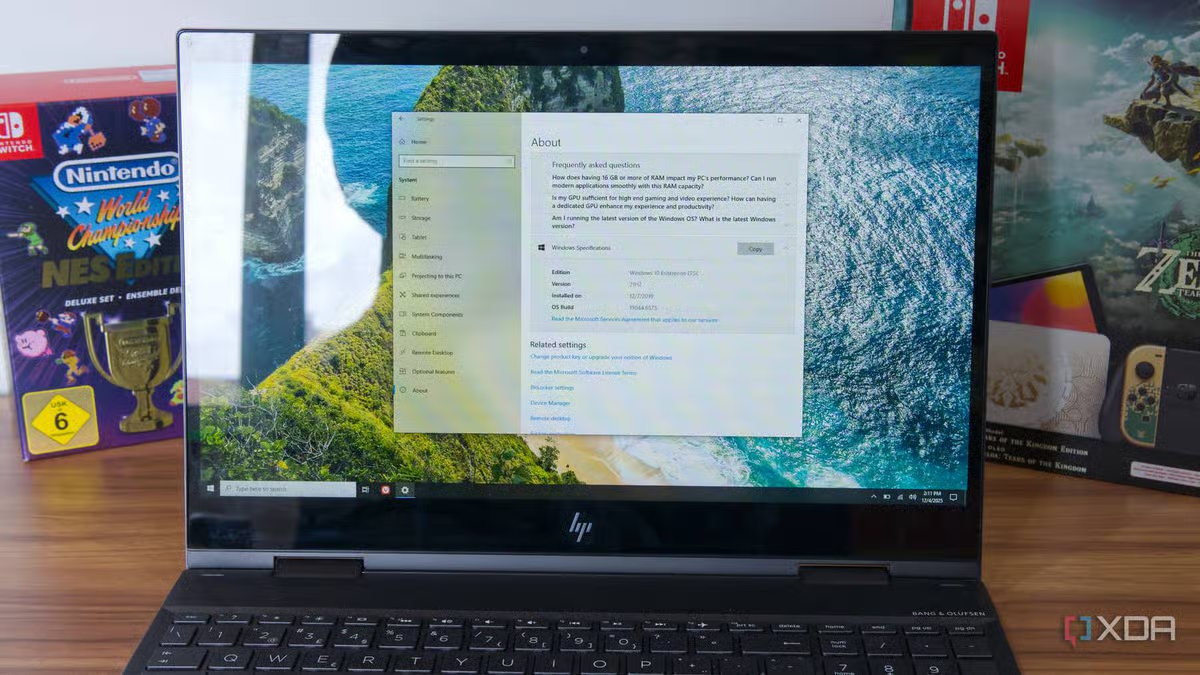 XDAMicrosoft's Windows 11 push backfired, so it's quietly keeping Windows 10 alive for another yearMicrosoft's Windows 11 rollout hit a snag, leading to an unexpected extension of Windows 10's lifespan