posted in Technology
ShellyForever — a 64-bit OS written entirely in x86-64 NASM assembly (with AI assistance)
Why I built this
I hate Unix commands. ls, cd, rm, mv, cp — two- and three-letter cryptic abbreviations that made sense to someone in 1971 and have just been carried forward ever since because “that’s how it’s always been.” I wanted a shell where the commands actually describe what they do, without needing to memorize a decades-old convention. So instead of complaining about it, I designed my own command set and built an OS around it from the ground up.
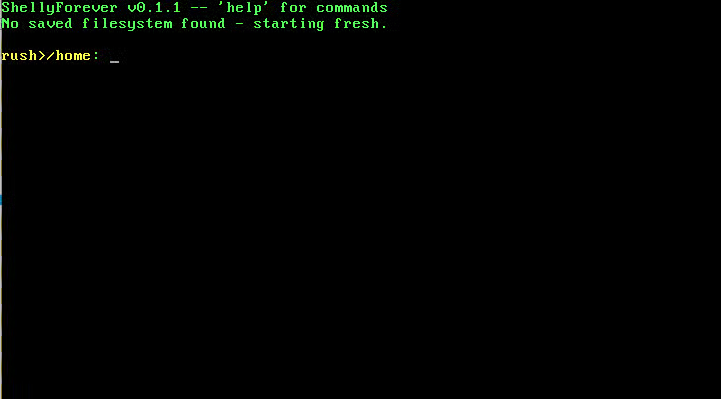
ShellyForever (currently v0.1.1) is a 64-bit OS written completely from scratch in x86-64 NASM assembly. No C, no existing kernel, no BIOS libraries beyond boot-time disk/keyboard calls. It boots and runs on real hardware, not just in an emulator. The name’s a commitment, not just a name — I plan to keep updating it forever.
To be upfront about how this was built: the assembly code itself is almost entirely AI-written. My part was designing the shell and commands — what each one should be called, how it should behave, what made sense to me as the person who’d actually be typing them — then having the AI implement that in asm and iterating with it on bugs and logic.
How it’s built
- Bootloader (
boot.asm) — 512-byte boot sector. Starts in 16-bit real mode, loads the kernel off disk, switches to 32-bit protected mode, builds its own minimal page tables, switches to 64-bit long mode, jumps into the kernel. - Kernel (
kernel.asm) — everything else:- A VGA text-mode driver (writes directly to
0xB8000) with scrolling - A polled PS/2 keyboard driver (decodes scancode set 1, handles shift, backspace, enter)
rush, the custom shell — prompt, line editor, a tokenizer that understands quoted strings, and a command dispatcher- An in-memory filesystem tree rooted at
/home, with recursive copy/move/delete - A simple
name = valueint64 variable table - A built-in line editor for file content
- A VGA text-mode driver (writes directly to
The commands (no more ls/rm/cd)
Command
Example
What it does
cf
cf docs, cf …
change folder
mkf
mkf docs
make a folder
mkfl
mkfl a.txt "text"
make a file with content (-force/-silent/-info/-test)
del
del a.txt
delete a file (requires auth)
rname
rname old.txt new.txt
rename a file or folder
owrite
owrite a.txt "new text"
overwrite a file’s content in place
cpy
cpy docs docs_backup
copy a file/folder (recursive)
mov
mov docs archive
move/rename a file/folder (recursive)
show
show “hi”, show a
print a message or a variable
list
list
list current folder contents
view
view a.txt
print a file’s content
find
find notes.txt
search every drive for a name, print its path
lookfor
lookfor “todo” notes.txt
grep a file’s content, with optional line range
edit
edit a.txt
built-in text editor
<n> = <value>
a = 5
set a variable
rmv
rmv a
remove a variable
vars
vars
list all variables
calc
calc 1 + 2 * 3
evaluate a math expression
rr
rr script.rsh
run a rush script file
prs
prs, prs kill 1
list/kill running scripts
auth
auth sdown
elevate for one dangerous command
current
current
print current path
wipe
wipe
clear the screen
dscan
dscan
scan drives for existing volumes
fmt
fmt data
format a drive with a volume label
mount
mount data
mount a formatted drive under /data/
label
label old new
rename a mounted drive’s label
ali
ali gs list
create a command alias
alis
alis
list aliases
color
color cyan
change output text color
sync
sync
save the filesystem to disk
rboot
rboot
save and restart (requires auth)
sdown
sdown
save and shut down (requires auth)
Some quality-of-life extras: command history and scrollback (arrow keys), ; to chain commands on one line, ~ to pipe one command’s output into another, $ for comments, and .rsh script files for automation.
Known limitations
No interrupts yet (keyboard/disk are polled), no real memory allocator (flat identity-mapped first 2MB), no ACPI (shutdown uses emulator magic ports on QEMU/Bochs/VirtualBox, halts cleanly on real hardware/anything else), and fixed-size file/folder tables for now.
Code
github.com/TheServer-lab/ShellyForever
Happy to go deeper on the boot process, the on-disk filesystem format, or the AI-assisted workflow if people are curious. Feedback welcome, especially from anyone who’s done bare-metal x86-64 work.