posted in Technology

OpenAI posts 700 maths preprints online: mathematicians are up in arms

The research community is in uproar after OpenAI released a trove of more than 700 mathematical preprints entirely generated by AI on 6 October. The San Francisco, California-based maker of ChatGPT posted the preprints on the software repository Github.

Although some mathematicians celebrated the solution of longstanding problems, others took to social media to complain about being scooped. Some were incensed at what one physicist called a ‘slopocalypse’, even if the mathematical content could end up being formally correct.

www.nature.com/articles/d41586-026-03196-8
enPage

Replying to @⁨lepinkainen@lemmy.world⁩

There are two issues really - one is a perception that they’re not vetting any of this output, just dumping it out on the internet and expecting real mathematicians to actually check it all, so yes if a human was doing the same thing it’d probably still be suspect.

The other is the widely held suspicion that much of the “breakthrough” mathematics here has been stolen from real researchers who’ve been using chatgpt to develop their theories by talking to it

Replying to @⁨CelloMike@lemmy.world⁩

The other is the widely held suspicion that much of the “breakthrough” mathematics here has been stolen from real researchers who’ve been using chatgpt to develop their theories by talking to it

I think that was just some rumor. In the end the accusation was that they basically brute-forced a solution using methods developed by someone else and claimed they solved it but those methods were public, not stolen because they used ChatGPT.

Replying to @⁨lepinkainen@lemmy.world⁩

I think there are three main issues (though I might be overlooking something):

  1. AI taking over peoples work is as much an issue for mathematicians here, as it is for programers, artists, writers, etc. elsewhere.
  2. We still need to check if these 700 papers are correct (AI makes mistakes at least as often as humans, usually more often). This involves a huge amount of effort. And if it turns out that they contain a bunch of mistakes, OpenAI is unlikely to care. To them, these papers have already served their purpose (generating headlines).
  3. Solving a problem in mathematics means being able to (formally) convince other people that your opinion is correct (massively simplified, but imo that is what mathematics boils down to), by getting them to understand why your opinion is correct. Having a pile of linear algebra spit out 700 texts about certain math problems removes the whole “human understanding” part of that.

However, it’s not entirely unprecedented for a computer to provide a proof that we don’t completely understand. I forgot the details (and I’ll edit them in if I can find it), but there was at least one problem that was solved using a computer and brute force trying millions of cases. That produces a proof much longer than any human could read in a lifetime, and iirc there where quite a few mathematicians unhappy about it at the time too.

Replying to @⁨zener_diode@feddit.org⁩

I can add about your last paragraph(it’s literally the core of what I do). There is a field of computer assisted proofs, that is mathematical proofs that need a computer to be completed.

The first and most well known example is the four color theorem. How many colors do you need to color “a map”. Answer: 4. Proof: very very long. By hand it is possible to prove that there are only 1834 options, and a computer was used to color all these explicit options. At the time, it was a scandal. Nowadays, other computer assisted proofs are accepted, such as the ones relying on validated computing: if a computer (with some restrictions and guardrails) can show that a certain value is over/under a given threshold then something else is true.

Then, there is the validated proofs approach. This is where Lean comes into play, if you have heard about it. You can ask a computer to check your proof. This is helpful for confusing, long proofs (most of math). You input all the logical steps you took and Lean confirms that all is logically sound. Many AI proofs are “Lean verified”, but there is controversy if they are proving what they claim they are proving. It’s also a massive chunk of code that nobody can understand.

Replying to @⁨Grimy@lemmy.world⁩

Just to give a comparison, a high-output mathematician publishes between 2 and 5 papers a year (depending on branch of math and dividing by co-authors).

Most are incremental work, so a little step towards solving a problem or a conjecture. A lot is just a “hey, look at this neat trick”. Solving “big problems” is usually the work of a decade or more, in which the mathematician is working on other stuff as well. So let’s roughly say that solving a big problem usually takes some 10 years of work and some 10-30 papers (assuming working roughly half time on it).

So on one hand, 1 paper per big problem is too little to actually understand what’s going on, on the other 700 papers are the output of more than a hundred mathematicians over a year. A math department in a university is around 50 mathematicians, I would say? So two medium-sized departments.

The other part of your comment. “If its proven and understandable”

At the moment, the preprints are assumed to be a shit sandwich. (Aka “would you eat a sandwich is there could be shit in it?” ). Using the results is just too risky without understanding if they are correct and how they are build.

The “understandable” bit is also really hard. I picked a random one in my field (nothing I directly worked on) and it was unreadable - mostly because of notation used without defining it and no explanation of what is going on, no overview or intuition. So to me it seems more shit than sandwich. As a reviewer, I would never accept such a paper.

Then finally, let is assume it’s all perfect and good. The goal of proving something in math is to develop understanding and a method to apply to other cases. So once all these papers are studied and understood, poop discarded, rest of the sandwich saved, ideally we will have new understandings of whole sections of math, new connection between items we’re weren’t aware of. What I think AI did in this context is to chain things that were already known, but there was no one whose knowledge spanned wide enough to know that all the pieces were already laid out. So it could be groundbreaking - once we remove the shit. How much shit there is is anyone’s guess.


Replying to @⁨lepinkainen@lemmy.world⁩

We all want the problems solved, right? Is there a wrong way to solve them?

Science is not mainly about solving problems (that would be engineering for example).

But more specifically to your question:

There are many wrong ways of doing scientific work, and what current AI does is one of them: reading it all, rephrasing it all a little and then already declare everything as done & good, even when it isn’t.

A scientist needs proof, and peer reviews, etc. before the work can be called good.

Never forget AI isn’t creating really new things, it can only chew up and spit out what has been there before. This is especially true in science.

Replying to @⁨lemonhead2@lemmy.world⁩

“Why is OpenAI trying to solve hundreds of math problems to be released all at once?”, he added.

even if the mathematical content could end up being formally correct.

It should be noted that none of what they released has been verified. Throwing 700 papers out there is intentional to generate buzz, “hey look how great we are”, and to slow attempts at proving or disproving their results. That way even if a few get disproven early they can still say “well that’s just a couple out of hundreds” because it’s gonna take forever to work through the slop dump. It could be a long time before we get a percentage of accuracy and by then most people will have forgotten or lost interest since the headline will be stale by then.

some mathematicians who might find their research projects pre-empted by the OpenAI release. “We should put that aside for today though. … he wrote, because it shows how quickly the technology has become useful to mathematicians.”

Yeah this fucks the researchers. Funding could get pulled from related projects leaving their work in hiatus until someone can check the slop for accuracy. Till then someone can just point to this and say “oh it’s already been solved” like it’s a done deal already.

“Look how useful we are!!!” Turns in unverified crap

Replying to @⁨cannedtuna@lemmy.world⁩

Throwing 700 papers out there is intentional to generate buzz, “hey look how great we are”, and to slow attempts at proving or disproving their results.

The Gish gallop is a rhetorical technique in which a person in a debate attempts to overwhelm an opponent by presenting an excessive number of arguments, without regard for their accuracy or strength, with a rapidity that makes it impossible for the opponent to address them in the time available. Gish galloping prioritizes the quantity of the galloper’s arguments at the expense of their quality.

The term “Gish gallop” was coined in 1994 by the anthropologist Eugenie Scott, who named it after the creationist Duane Gish, described by Scott as the technique’s “most avid practitioner”.[1][2]

en.wikipedia.orgRhetoric - Wikipedia

Replying to an earlier post

well what I mean is they will throw out things and when challenged or fact checked then go to a new thing. sometimes not new but proved false long enough ago that people forgot. but yeah a lot is poorly done to begin with but its using large amounts and going to a new one if its disproved and actually ignoring that they ever used it. Oh and then attacking fact checking places as being political for pointing out facts or yelling at news entities for doing it.

Replying to @⁨lemonhead2@lemmy.world⁩

I saw the Wired article yesterday, it’s worse than it sounds.

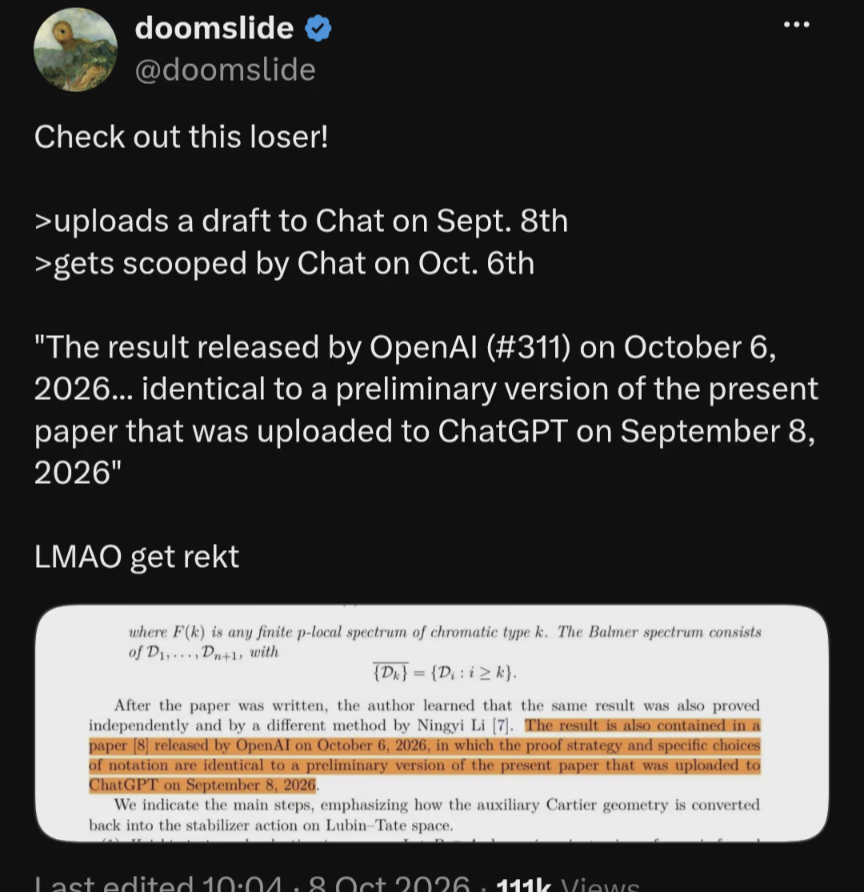
For at least one of the problems an OpneAI researcher initiated a partnership with a mathametician, loaded all of his work into a chatbot without his knowledge, and then published the result as 100% from the chatbot in this “trove”.

When the mathematician confronted the OpenAI employee, he was told sharing credit was “too complicated” so they wouldn’t acknowledge he had already mostly had it done. When he tried to push back, OpenAI then threatened his career if he tried to tell people what had happened.

It’s is very very unlikely that was a single case. If that happened once, they definitely at least tried it more than once.

Even if it actually solved anything, taking in years of human work and then spitting out one last step is nowhere near what they’re portraying this as. They’re intentionally making it sound like they just gave the chat or the problem and it solved what a human couldn’t.

All it did was steal human work and rush publication

Replying to @⁨givesomefucks@lemmy.world⁩

All it did was steal human work and rush publication

Ok, but literally all it does is steal human work and provide an output.

I wonder how the mathematician expected it to go. Was he expecting to be directly provided the AI output so he could publish it? Was he going to care if the AI used a novel approach he hadn’t employed and was unable to identify where it got it from? We have seen since the beginning that AI has an attribution problem, so it seems like his actual concern was that HE wasn’t credited.

I’m not an AI supporter, but this whole “it did just a small part” complaint is weird to me. I believe I read that most were solved in 3 hours of compute. I’m sure the mathematician wasn’t just 3 hours from solving the problem. It did it faster than humans did. Isn’t that the point? Does it matter how little the step was if it hadn’t been taken yet? It could’ve taken mathematics years to make that last step. Shouldn’t we be excited to see this development? If we’re going to have AI, isn’t the point that it accelerates problem solving. If AI sped up life saving medical research by years or even just months by doing one last step, would people be having the same reaction?

I’ve seen the same people complaining about this regularly talk about using AI for coding. Why is it ok that so many companies have put programmers in this position, but all the sudden it’s bad for mathematicians?

Replying to @⁨givesomefucks@lemmy.world⁩

Solving math proofs with AI is like doing art with AI. Pointless. In fact, it is detrimental to the discipline as a whole, because doing so means people will stop sharing work and insights with each other, which has never been the case before (at least it’s not the norm).

As discussed on MathandAI.org and elsewhere, top mathematicians “disseminate ideas in talks, private discussions and careful writeups, connecting them to the previous ideas of others. These processes invariably take time and are based on human interaction.”

AI is undermining this process, as people naturally become less willing to discuss ideas that can easily be stolen.

Replying to @⁨givesomefucks@lemmy.world⁩

I’m actually paraphrasing Terence Tao and some of the top mathematicians on the planet. These discussions have been prevalent across the maths community.

It’s not common knowledge, but mathematical proofs aren’t intrinsically valuable (in any way whatsoever) outside of the mathematical community capable of deriving them. They are valuable because they create a mathematical community, not the other way around.

Scientific discoveries are different. Scientific insights without scientists are still useful to society. Not so mathematical proofs without mathematicians.

mathandai.orgDeclaration — Math and AIRead the declaration and add your name.

Replying to @⁨yeahiknow3@lemmy.world⁩

I’m actually paraphrasing Terence Tao

That doesn’t even mean you’re saying the same thing bud…

Non-mathematicians don’t realize this, but proofs aren’t intrinsically valuable outside of what they mean about the community capable of creating them.

Do you think “non-mathematicians” think solving a math problem magically gets someone a check? Like, if anythi g you have it backwards

You’re way off on everything though.

You should paraphrase less, wait till after you understand what you’re reading.