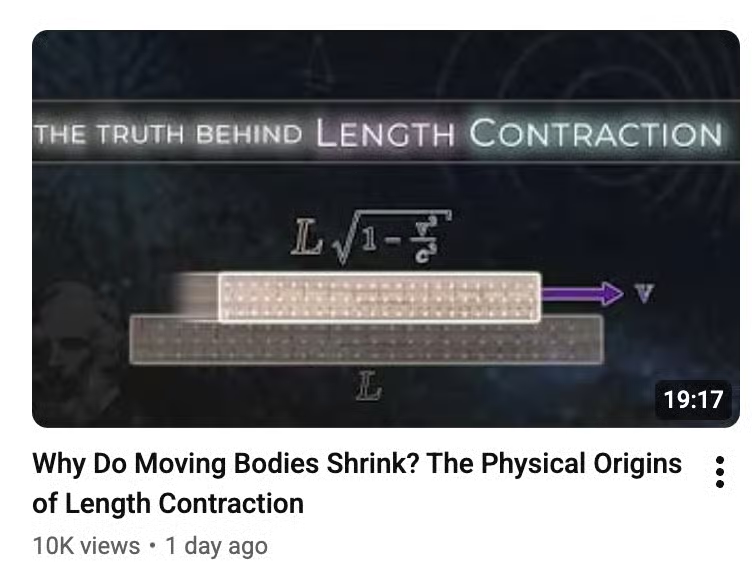
okay so i saw a video that claimed that you can get all of special relativity without fixing light speed
and it seems that's true.
and i know that you can get (presumably) all of QED via pilot wave stuff, which has no 'quantum weirdness' (except for non-locality, but nobody cared about that before einstein).
so is all the last hundred years of physics just people caring too much about single interpretations of much broader ideas?
1. Military / Robert Maxwell / etc doesn't really want you having a SIMPLE model of the universe, because then you're gonna infer how to do stuff like manipulate gravity and inertia and cause their whole social control juggernaut to fall apart. So they promote a specific view that is annoyingly complex and leads to a lot of dead ends if you try to follow it.
2. Trying to walk away from the mainstream model is HARD, there are a million different ways to look at things, even if you model 90% accurately you still have LOADS of phenomena that you can't explain, you can shuffle it around a little bit and then you explain a different 90%, but it's hard to figure out which theory works the best, it's really easy to just Get Lost.
This one is specifically interesting because I derived my own explanation for this.
The Michelson and Morley experiment was unable to detect a medium through which light passes. The idea of the experiment was to bounce light back and forth, right and left at the same time, and if the earth is moving through the medium, and light speed in that medium is constant, you should detect a speed difference between the two axes.
They detected nothing, so Einstein argued there is no medium, light is not really a wave, it's also a particle, and it's not moving through a medium, it moves through Nothing..
But there were two other issues that needed to be resolved, and they were resolved via time dilation and Lorenz Contraction (the topic of that video)...
Lorenz Contraction doesn't really make any fucking sense, except that it happens to perfectly fix the experiment so you won't see any effect... But, if you imagine for a second that every orbiting atom is a little tiny Michelson and Morley experiment, and the spinning electrons are also limited to light speed, then you can just say "it contracts because the orbit is squeezed"...
So the explanation of why the experiment always produces a null result is because every atom in the device is also doing the same experiment, and when you add up the squeezed atomic orbits and the bouncing light and everything sums to zero - because of course it does.
Now you've got time dilation, and we positively know this is real, clocks absolutely do slow down when they're "moving faster" - but this is an absolute fuckery for Einsteinian physics because Einstein says there's no preferred frame of reference - i.e. no definition of "stationary", so how can there be a definition of "faster"...
When you pose this question, the mumbo-jumbo and hand waving comes in heavy.
But lets return to the aether hypothesis again... We posit: electrons orbiting an atom are governed by C - so when you're going forward, their forward travel is much slower, their backward travel is (equally) faster, but their side/side travel is somewhat slower (which is not cancelled out by anything).
Now we suppose that everything we can use to build a clock is somehow dependent on atomic orbit speeds. After all, atomic clocks are directly measuring atomic orbits, and it's not really that much of a stretch to suggest that every other process that runs at a stable rate is likewise stable relative to atomic orbits...
Then we have our solution: When something moves faster (relative to the aether), the atomic orbits are slowed down, meaning everything slows down.
And yet we STILL can't measure our speed in space, because when we launch a clock off in one direction and another one in another direction, we have to get them back in order to check which one lost time, and getting them back means they both have to do the inverse of their original trip - and so they both end up showing slower than our clock that we kept "stationary"
Also since I like to offer discounts for people who want me to do something I wanted to do anyway, if the mission is to sit on the patio, drink cocktails, and not read anything related to a person by the name of "Greene", I think we can work out a really advantageous deal.
You have to sit with the Michelson and Morley experiment for a bit to really see how it's supposed to work, because it's a little bit inobvious.
Once you see how that's working, then if you imagine an electron going around in an orbit - if (we conjecture) that electron's speed is actually a fixed number relative to C, and furthermore we imagine that Michelson and Morley were right and there IS an aether, then you can infer that the forward/back part of the electron's orbit will be faster than the right/left part (with forward defined in terms of the direction of travel of the moving body in the aether)
@cjd that channel has a few vids that give time dilation a physical explanation as well, and of course there's also shape dynamics which reproduces realtivity without any time nonsense and it's not even dealt with there
I'll have to check it out... Like I said, I inferred all of this myself because I find the introduction of "time" as a physical dimension to be malarkey. I think processes play out - sometimes at reliable rates - and that's that.
Furthermore, I think Lorenz, Michelson, Morley, and others were on to something by proposing there is an aether, and I think Einstein was perhaps justified initially in arguing against it because it "added complexity", but then as he expanded his theory to handle more previously unhandled phenomena, it became more complex to avoid aether.
Or more to the point: I think aether is easier to believe in than "time".
I'm not that keen on taking stuff on from people that don't come with an introduction, but seeing as we're mutuals on here I suppose I can consider it.
In any case, we usually start things off talking about budget and goals...