posted in Technology

US accuses American of allegedly wiping his phone using a 'duress' password during border search

cross-posted from: lemmy.world/post/49853131

Feels to me like GrapheneOS did exactly what it should, passing the US border test with flying colours!

Funny part about this lawsuit: “With a little planning ahead of time, you can always download the data you need once you get to where you’re going,”
techcrunch.com/2026/07/24/us-accuses-american-of-allegedly-wiping-his-phone-using-a-duress-password-during-border-search/
TechCrunchUS accuses American of allegedly wiping his phone using a 'duress' password during border search | TechCrunchA U.S. citizen has asked a court to throw out the government's claim that he gave over a passcode to border authorities that wiped his phone's data, opening up fresh questions about a person's constitutional rights at the U.S. border.


Replying to @⁨madeindex@lemmy.world⁩

Perfectly legal. Unless they were legally charged and ordered by a court to preserve data considered to be used in a crime, they can’t be charged with shit. Cops don’t dictate this, courts do, AND that scope only applies to an active prosecution anyway.

Edited ⁨⁨Jul⁩ ⁨24⁩, ⁨2026⁩, ⁨21:05⁩⁩en

Replying to @⁨CompactFlax@discuss.tchncs.de⁩

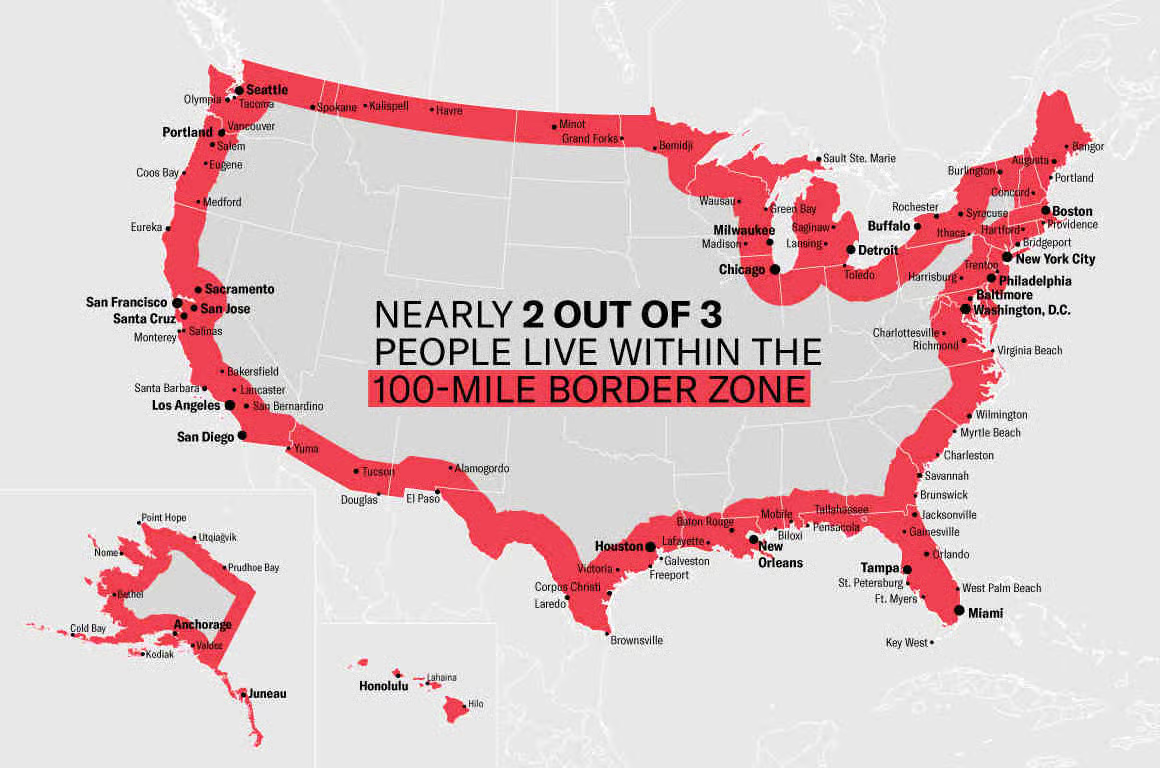
100 miles, but it does not include airports. www.aclumaine.org/…/100-mile-border-zone/

ACLU of MaineKnow Your Rights: Customs and Border Patrol and the 100-Mile Border Zone - ACLU of MaineAll of Maine is within 100 miles of the border, meaning CBP has broad authorities. Know your rights with CBP in Maine. The Fourth Amendment of the U.S. Constitution protects people from random and arbitrary stops and searches. But U.S. Customs and Border Protection (CBP), which includes U.S. Border Patrol, operates broadly in border areas. […]

Replying to @⁨CompactFlax@discuss.tchncs.de⁩

Search is not the same thing. Search means they CAN legally search. It absolutely does mean that wiping your phone prevented, obstructed, or obscured a SEARCH. Search all you fucking want, that data is gone. It’s not retroactively comparable.

That being said, had there been a judge that said “You can’t wipe your phone, because you are being charged with a crime, and we believe there is evidence of this crime on your phone, and here is why…”

Way different, and these laws only exist to prevent law enforcement from being caught in a cyclical legal roundabout in court related to the 4th amendment, and even then, many defense lawyers get “gray area” material data evidence thrown out because of Miranda Rights, or illegal searches by law enforcement of data harvested when the defendent was not properly advised or advocated for their ability to refuse.

Murderers get off for this shit because Cops get overzealous and don’t follow the letter of the law or chain of custody in evidentiary collection.

Replying to @⁨just_another_person@lemmy.world⁩

From the article

“The government’s indictment, which contains a typo (“Untied States Code”), accuses Tunick of allegedly providing a passcode to border agents that caused the phone to “delete the digital contents,” prior to the device being seized.”

“When Tunick provided his passcode and the authorities entered it, “the screen went blank, flashed several times and the phone appeared to restart.” The authorities seized his phone anyway, before telling him that he was free to go and could enter the United States.”

Replying to @⁨just_another_person@lemmy.world⁩

No it can be police that charge.

My state 100% has this law and police charge suspects for this.

ORC 2921.12 Tampering with evidence.

(A) No person, knowing that an official proceeding or investigation is in progress, or is about to be or likely to be instituted, shall do any of the following:

(1) Alter, destroy, conceal, or remove any record, document, or thing, with purpose to impair its value or availability as evidence in such proceeding or investigation;

(2) Make, present, or use any record, document, or thing, knowing it to be false and with purpose to mislead a public official who is or may be engaged in such proceeding or investigation, or with purpose to corrupt the outcome of any such proceeding or investigation.

(B) Whoever violates this section is guilty of tampering with evidence, a felony of the third degree.

Replying to @⁨Zen_Shinobi@lemmy.world⁩

In your Section A right there: “official proceeding”

There was no crime in progress, suspicious activity, or active charges brought against this person.

Maybe reread the article.

Also, Police do not bring charges, Prosecuting Attorneys do. Police are only responsible for investigations and arresting. Everything else is cleared by the legal system first.

Replying to @⁨just_another_person@lemmy.world⁩

You’re wrong and arguing in bad faith now.

People get charged with tampering for all types of shit, like eating drugs during an arrest. The laws surrounding the bordes are dumb as fuck, but legally-speaking border operations can be construed as official proceedings, although it’s only an investigation that is required. Which it obviously was.

Prosecutors ultimately argue charges, but police organize those charges before presenting them to the the state.

Knock it off. Stop being a contrarian weirdo.

Replying to @⁨chloroken@lemmy.ml⁩

You seem to have zero knowledge on the subject, so let me educate you a lil bit:

Data isn’t treated like physical evidence.

Drugs and weapons are physical evidence.

US laws do not cover any protections of ephemeral (non-physical) evidence pertaining to crimes committed ex post facto: meaning law enforcement is not privy to any and all collection of said data if not in scope for a crime committed, unlike…PHYSICAL EVIDENCE.

You can see drugs. You can hold drugs. Law enforcement can make a reasonable assumption that someone shooting a gun in public is breaking the law and seize that gun, because they are actually breaking the law (juris laws dependent) by firing the gun.

If suddenly our laws allowed the assumption that whatever exists on a phone for a random person in public contains something related to a crime, police would be able to stop anyone and everyone on the street everywhere and take their phone or data for simply thinking every person is suspicious. This is why the 4th amendment exists, and why police are enot allowed to do such things. His is why warrants are a thing.

Read up.

Replying to @⁨CompactFlax@discuss.tchncs.de⁩

Not every search is comparable to one another. Searching a car for immigrants near the border fence is one thing while searching an American citizen’s personal phone containing all kinds of private informatoon at an airport in the middle of Georgia is another. This is all based off allegations of CSAM, but I would imagine the federal government would actually have to make a case for why they suspected CSAM in the first place to make the seizure legitimate. In reality, they probably wanted this guys messages and phone calls related to his activism so that they can target those people too, which is going to be hard to make a case for in court depending on the judge.

Replying to @⁨just_another_person@lemmy.world⁩

It depends. If the police suspect the owner has evidence of some sort on the phone, destroying it can lead to a tampering with evidence charge from the police.

A tampering charge doesn’t have to be from a court order. If someone eats or dumps out drugs where the police can’t collect the physical drug, it will stick.

But in the story’s case, it falls within the 100 miles of the US boarder (called a boarder search exception) a warrant, probable cause, or RAS aren’t needed here. It’s considered a reasonable search so the 4th amendment is limited here.

There is a lot to it and really don’t think this is the best format for it here.

Replying to @⁨chloroken@lemmy.ml⁩

Did you read the article and the laws pertaining to data seizure at the border? Crossing the border doesn’t constitue an investigation of ANY kind, and also doesn’t suddenly conjure up some sort of suspicion that a crime is in progress or has been committed, meaning no pretense for charges because PERSONAL DATA was not seized. Good lawd.

Replying to @⁨just_another_person@lemmy.world⁩

Perfectly legal. Unless they were legally charged and ordered by a court to preserve data considered to be used in a crime, they can’t be charged with shit. Cops don’t dictate this, courts do, AND that scope only applies to an active prosecution anyway.

I’m not a lawyer, so I’m not arguing that you’re wrong here, but the article describes the federal law the journalist was charged with. It seems very broad, and it’s a bullshit law, but from what’s here, it seems more grey area than perfectly legal. All of 2232 seems to require knowledge (which it seems like he had, but might be arguable) and action. You could argue that the journalist didn’t take any affirmative action to wipe the phone. The action that wiped it was the feds entering a code.

LII / Legal Information Institute18 U.S. Code § 2232 - Destruction or removal of property to prevent seizure