Replying to @iris@neuromatch.social
Nothing has prepared me for why the conjugation of anfangen involves putting an at the opposite end of the sentence. That will take me a very long time to master.
Structural biology (XFEL crystallography, cryoEM, electron crystallography) data processing methods developer. I use my degree in chemistry to write software to use physics to understand biology. As of 2024, based in Hamburg. Ich hätte gern, wenn du mein schlecht Deutsch korrigierst, ob du das willst.
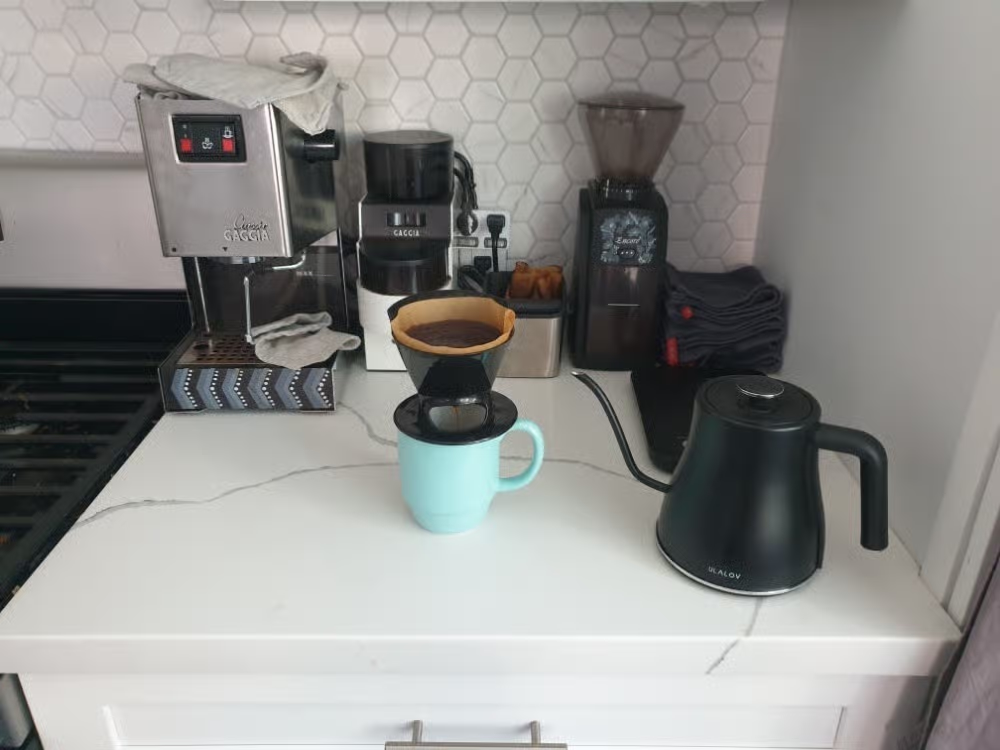
70% coffee by volume. I’m really into electronics, 3D printing, and sewing right now, and trying very hard to learn German. I have a very fluffy and affectionate cat. Big fan of bicycles and trains, better public infrastructure generally, and investment in collective wellbeing generally. Food motivated; very easily bribed with coffee and pastries. Always learning. On the spectrum (hard X-ray, ~12 keV).
I'd rather you get a sense of my values from checking my feed, but in very-very-brief, fascism is bad, open source and open science are necessary but not sufficient, and the right to repair includes yourself.
Hugs: yes please. Flirting: no thank you. Please have your bio filled out when you follow-request.
Replying to @iris@neuromatch.social
Nothing has prepared me for why the conjugation of anfangen involves putting an at the opposite end of the sentence. That will take me a very long time to master.
Paying attention to what mistakes German speakers consistently make in English is highly instructive as to how the equivalent constructions will be unintuitive to me in German. One that I've noticed across multiple languages is whether to make one or both verbs past tense or conditional in compound constructions, e.g.
"Didn't you went there yesterday?"
"I thought that will be helpful"
"I didn't know that will bother you"
These all tell me what the natural construction would be in the speaker's native language. I am always excited to notice such things.