Replying to @PRIMEcavitationfetishist@quokk.au
Ghislaine Maxwell develops class consciousness
I’m just joking, she already has it, along with the other billionaires
Replying to @PRIMEcavitationfetishist@quokk.au
Ghislaine Maxwell develops class consciousness
I’m just joking, she already has it, along with the other billionaires
Replying to @joe@lemmy.world
Honestly, they shouldn’t be.
Replying to @return2ozma@lemmy.world
I paid $450 for a single room in a house share ten years ago. Now it’s $850 for rooms on the same street
Replying to @joe@lemmy.world
I straight up almost called it a series of tubes, lol.
Yeah, that’s probably why I do think of it as a shared network, I just don’t play online games, so that’s not what I associate with the internet.
Replying to @joe@lemmy.world
As a non-techie: websites are the internet.
Like, I conceptualize the internet as basically just a giant shared network, but the point of it is the websites (for me).
I apologize to anyone I may have just gravely offended.
Replying to @treadful@lemmy.zip
I think of it the way the ACLU thinks about defending racists: it’s totally irrelevant whether or not the joke is fucked up.
The US has worked itself into a horrible situation whereby the protection of the second amendment comes at the cost of all other rights for citizens. Trying to do this without coming out and saying so results in an enmeshment of industry and government that would make Mussolini proud.
I can theoretically understand why terrified parents who can’t think of any other way to protect their children might want this, but that doesn’t make it acceptable. They’re selling everyone out for the appearance of temporary protection from the real problem.
Replying to @GrabtharsHammer@lemmy.world
As his faculties return, Robert (who has always been technophobic) must adapt to a different world, where almost every object is networked and mediated-reality technology is commonplace.
…
However, jitter and latency are considerable problems with this basic network when long distances are involved. In the novel, Robert Gu develops an algorithm that partially compensates for these technical deficiencies, and might ultimately allow the inclusion of haptics.
This feels like it would be a little Mary-Sue to me, but I haven’t read the book. Is that transition handled well?
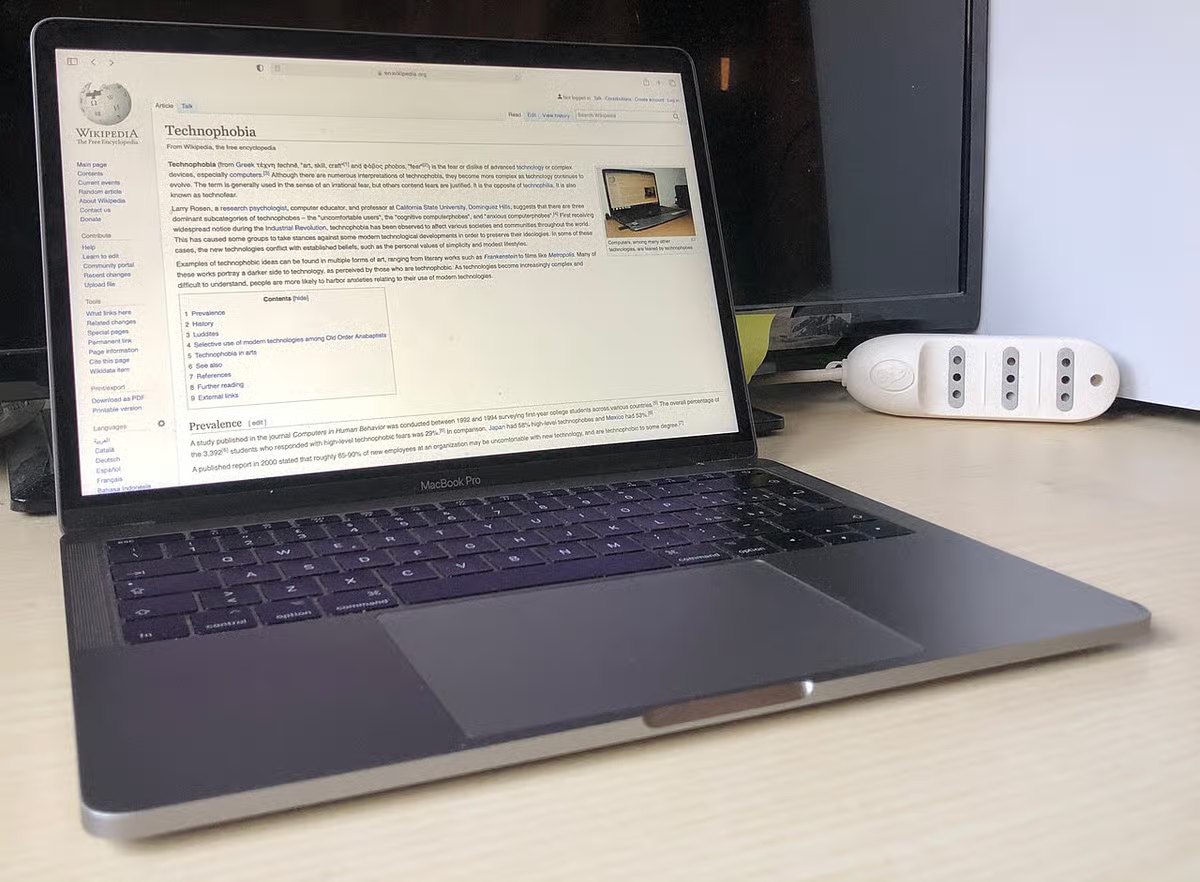 en.wikipedia.orgTechnophobia - Wikipedia