posted in Technology

Bernie Sanders proposes 20 year prison sentence for AI devs who plow ahead with Artificial Superintelligence plans - penalty on par with illegally developing rogue nuclear weapons

www.tomshardware.com/tech-industry/artificial-intelligence/sanders-proposes-20-year-prison-sentence-for-ai-devs-who-plow-ahead-with-artificial-superintelligence-plans-penalty-on-par-with-illegally-developing-rogue-nuclear-weapons

Replying to @⁨Mustachius_Grumpius@thelemmy.club⁩

This is nice and everything, but this whole thing is just a huge marketing push by AI companies. AI is not going to kill us. At least not directly (see point 2).

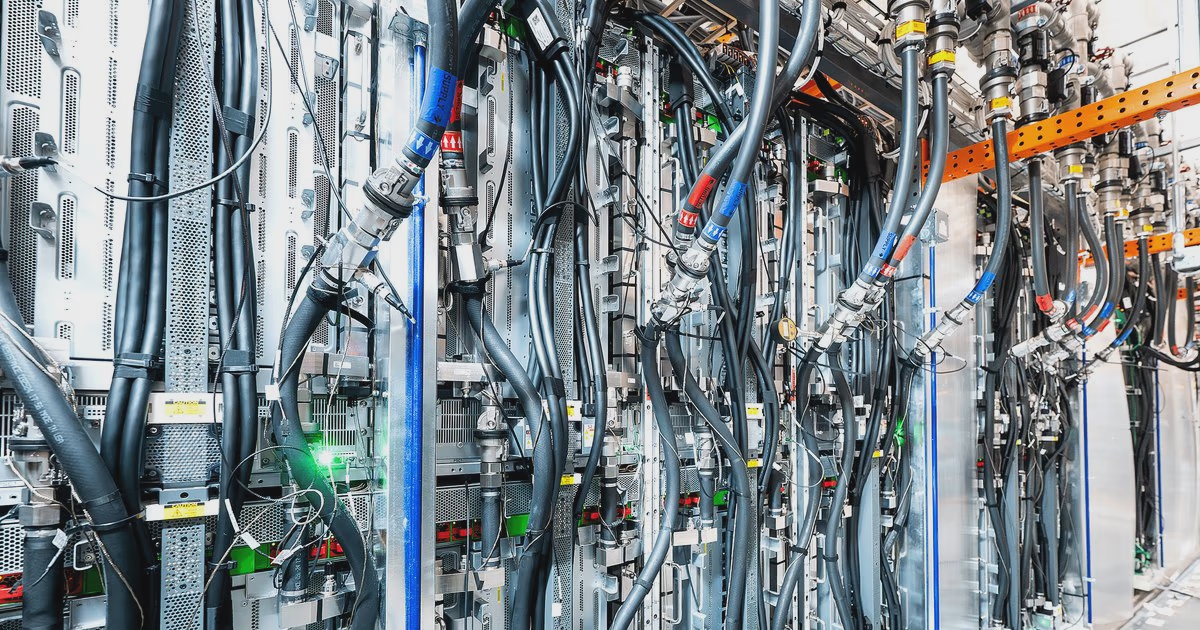
  1. You need prohibitively expensive equipment to host AI. That equipment needs to be plugged in. If it were truly dangerous, you just need to unplug it.

  2. You need a lot of water to cool the equipment that can run a supposed super intelligence. If we pass regulations about how much of our environment these data centers can destroy, that would curb the abilities of this superintelligence.

  3. AI is fucking dumb. AI is a misnomer since it doesn’t actually have any intelligence. It is derivative and cannot perform any necessary tasks that actually drive intelligence. For example, it will be able to tell you every established law in any field of science because it has that information in its corpus, but it will never be able to establish a new law. Or discover anything new in any field.

This whole thing is a push to get people to believe that AI is more capable than it really is so that these companies can draw more money from investors so that 'they’d be able to implement proper safeguards."

Replying to @⁨kn0wmad1c@programming.dev⁩

Point 2 isn’t really true, closed loop systems exist and are becoming the standard.

Point 3 is just obviously false? techjournal.org/openai-astra-solves-open-math-pro…

OpenAI Astra math breakthroughTech JournalOpenAI Astra Solves 10 Open Math Problems for $2,000OpenAI's unreleased Astra model solved 10 decade-old math problems with verified Lean 4 proofs for ~$2,000 in compute. Here's what it means for AI and you.

Replying to @⁨communist@lemmy.frozeninferno.xyz⁩

Data centers use evaporative cooling, not closed loop. You can’t really scale up in a closed loop system. Evaporative utilizes a ton of water.

As for point 3, supercomputers have been assisting with scientific problems for decades now. This isn’t new, just new tech applied. Your article is actually the best way to use AI, imo. It will be better at finding patterns in data than humans will ever be.

But my point is to say would it have been able to discover that those math problems existed in the first place?

No. The answer is no.

Replying to @⁨kn0wmad1c@programming.dev⁩

Yes you can obviously use a closed loop system and scale up? it’s even becoming the standard? datacentremagazine.com/…/how-closed-loop-cooling-…

That is a massive goalpost shift. You went from can’t do anything useful to couldn’t have discovered the problems in one step?

Why does it even matter if it can’t discover the problems if it can solve them, exactly? And why could it solve the problems and not discover new ones?

How Closed-Loop Cooling Is Reshaping Data Centre Designdatacentremagazine.comHow Closed-Loop Cooling Is Reshaping Data Centre DesignData centre operators are reducing water waste and energy consumption with closed-loop systems that promise sustainability without sacrificing density
Edited ⁨⁨Sep⁩ ⁨14⁩, ⁨2026⁩, ⁨16:02⁩⁩en

Replying to @⁨communist@lemmy.frozeninferno.xyz⁩

How do you get “it isn’t useful” out of that? If you have to extract a wild interpretation out of what (I thought) were pretty clear words, your argument isn’t as strong as you think it is.

And yes, I read the article. It’s speculative for existing data centers, which are the problem. There’s no incentive for them to spend the money to switch to closed loop.

New data centers aren’t incentivized to go that route either aside from the environmental impact. It would be nice if they were, though.

Replying to @⁨communist@lemmy.frozeninferno.xyz⁩

I never said or implied that it’s useless. You’re deriving meaning where there is none. It’s a tool and tools are always useful. Here’s an example of a supercomputer (not AI) designed to solve unresolved mathematical equations and scientific problems

Same idea, doesn’t need AI to do it.

My point was, and is, that it cannot replicate human intelligence and that it doesn’t have intelligence on its own.

Replying to @⁨communist@lemmy.frozeninferno.xyz⁩

I’m not the guy you’re arguing with, but it will be interesting to see if/how LLMs deal with novel Gödel sentences in a way that is more than just mimicry. I’m sure there is a way to set this up that is mathematically rigourous.

The idea is that there are some statements which are true but unprovable in a formal system. Since LLMs run on a computer they are technically a formal system of sorts. So it will be interesting to see if they can pinpoint the true yet unprovable sentences. If they can it will lead to a lot of interesting questions about how exactly they know it’s true without “proving” it in some roundabout way.

I’m not doing this issue justice. A lot has been written on this by Roger Penrose (you don’t have to agree with his stance to appreciate that he’s touching on an interesting problem, here).