Arguably Nepal's most well-known folk song, though not that old, Resham Firiri's melody is catchy and its lyrics open to interpretation. The title means "silk flutter"; flutter in an onomatopoeic sense. Many think of a silk scarf blowing in the wind, but it may actually refer to a bee flying past during a walk, and telling it what you've seen, etc..
“Buzzing bee, buzzing bee. Shall we fly over or sit at the hilltop? Buzzing bee."
#Music #Ethnomusicology #WorldMusic
https://www.youtube.com/watch?v=qwDBE-87NWE
Cassana 🍻
Talking life, #music, #ethnomusicology, #history, #linguistics, #science, and throwing in my own brand of humour and randomness whenever I feel like it. Always exploring new, and sometimes strange roads, steered by my curiosity and creativity. #Musician #MultiInstrumentalist
I'm thee owner/admin of the Crossroads Inn. 🍷🍻
- Language
- I primarily post in english, though may boost toots in other languages or reply in Dutch, German, etc.
- Ethics
- I'm opposed to ideologies claiming absolute authority, superiority, purity or truth, so no nationalism, racism, extremism, etc. That said, I won't often post about politics or conflicts here. Given my global focus, that could take over completely.
- Favourite proverb: Yiri bɛ se ka sigi ji kɔnɔ san caman, nka a tɛ se ka kɛ bama ye
- "A piece of wood can sit in the water for many years, but it can never become a crocodile." in situations you'll be seen as different, and that's OK. Don't pretend to be something you're not or allow people to force you to deny your roots and experiences.
Replying to @menelion@caneandable.social
@menelion Technically the jetigen is a zither; the strings are parallel to the soundboard as opposed to perpendicular for harps. Forgot to mention that one. Kazakh music is interesting to me in how it links up to wider Turkic groups and beyond along the Silk Road, but I haven’t done a real deep dive. And I’m still unsure how I feel about Kazakh opera, a mix of western classical and Kazakh folk.
Replying to @menelion@caneandable.social
@menelion There are other Kazakh instruments that might be interesting too; kobyz, sybyzgy, etc. I always encourage people to explore, and that doesn’t have to result in falling in love with a given musical tradition or instrument. If it does, awesome! The exploring and learning is the key thing. I also often tell people: “8 billion people on this planet, but 261 billion tastes in music. It shifts with time and the weather, or something.”
This is S. Cerenčimed with Зүүдэн бороо (Züüdén Boroo; dream rain). It's a classic Mongolian song, which was apparently composed on a train. This is vocals and yatga, a zither. Modern ones have 21 strings, but historically there were commoner (10-string) and court/monastery (12-string) versions. The poetic lyrics express longing and sorrow:
"In the midst of sleep a dream-rain falls. My dampened pillow leaves my cheek feeling forlorn.”
#Music #Ethnomusicology #WorldMusic
https://www.youtube.com/watch?v=-oDRe7HECKA
Replying to a post on pagan.plus
@Cat_LeFey Also, the number is skewed, e.g., there may be 1.422 billion catholics according to the Vatican, but how many of those are really more secular now? Many probably.
I stopped attending church around 1997, but didn't request a note of departure to be placed in the baptismal register until 20 years later. Many people never request that or know about it. Even then, theologically baptism is permanent and the entry won’t be deleted, just appended to that you’re no longer an active member.
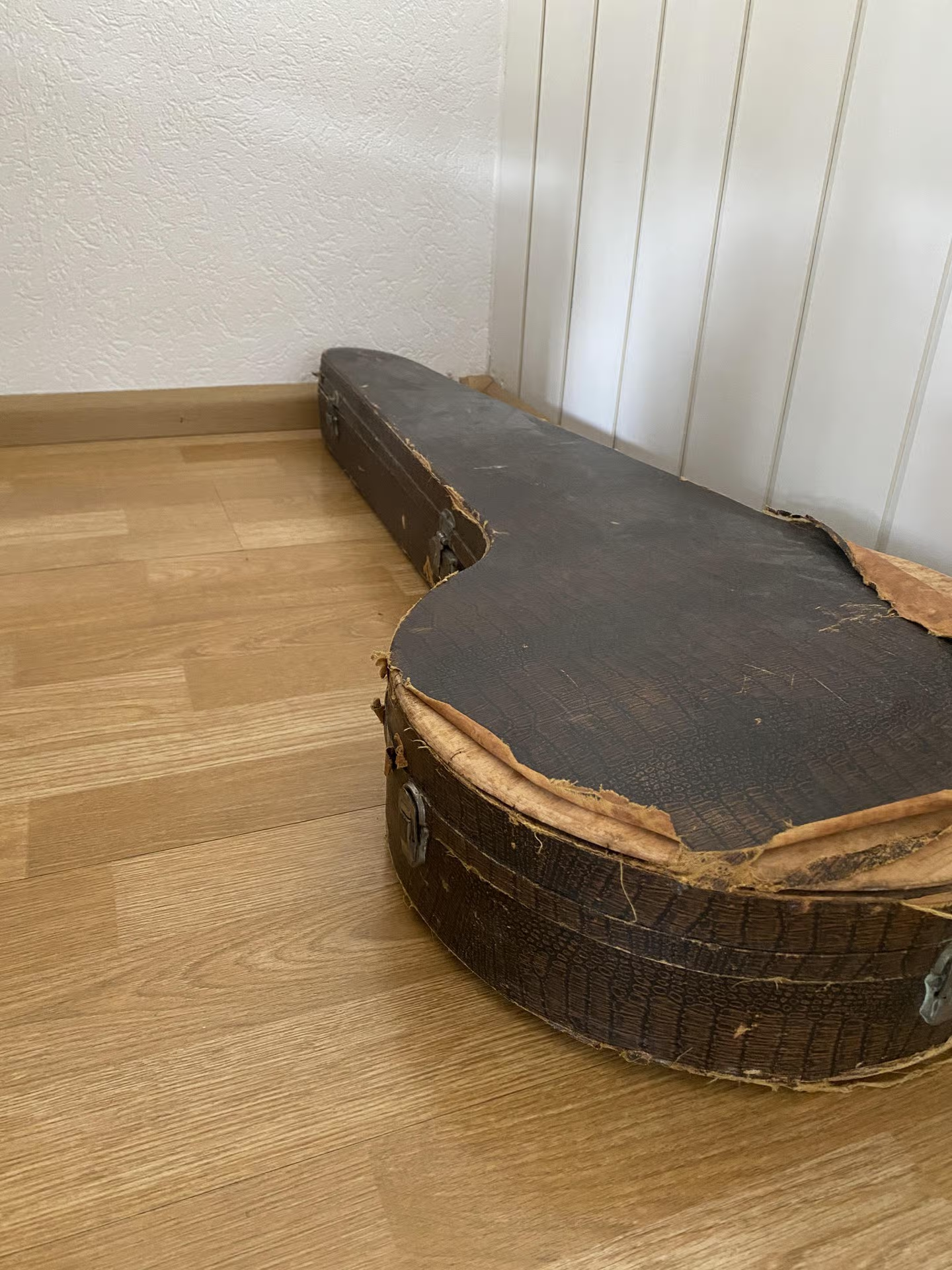
Today's random thought: Do I have a poltergeist living in my antique #banjo case? I swear that one bracket nut was not loose like this earlier today. Both the banjo and case are likely 1930s. The case is seriously banged up and unsuitable for safely carrying the instrument around anymore, but just for storage it’s fine. If any case could have a poltergeist, it’s probably this one. #Instrument
Waking up to steady light rain is nice. A gentle soaking of the parched earth.
Replying to a post on beige.party
@MamaLake @urholaukkarinen I like listening to all kinds of soundscapes, not just those special natural spaces, but also cities and just different perspectives. I know people who recorded London from the perspective of their moving house boat. That was wonderful, though I don’t think I have those anymore.
Replying to a post on the-crossroads-inn.com
I smelt smoke outside, so I’m reading up on wildfire news. It looks like there’s also one in the High Fens, pretty much across the German-Belgian border from the Hürtgenwald; both are part of the wider northern Eifel-Ardenne area.
Replying to a post on dobbs.town
@kilroy_was_here @Tarnport Oh absolutely! There were a couple of years where I did a fair bit of sailing. Racing along on a catamaran is one of those things where you really experience the power of water and wind. I was often the person doing the trapezing too, and hanging out there, pretty much standing on the side of a racing cat, there's just nothing like it.
Replying to a post on musician.social
@elsemusic True, which is why I QP’ed; sharing while also critiquing. In general I think it’s wonderful people are getting more interested in microtonality, though I unfortunately do come across a lot of misrepresentation and simplification about microtonal theory and traditions regularly. I’ve been studying Turkish makam theory for 15 years now and there’s still so much to learn, and learn to put into practice.
Replying to a post on mastodon.green
@Tarnport Every Saturday morning during my childhood we would go to my grandparents’ farm. I learnt a lot of things there, like planting, taking care of and picking vegetables, herding cows from one field to the next, splitting wood, driving a tractor (only in the fields of course), using knots, braiding ropes, etc. etc. Not skills I use nowadays, but I regularly find it has influenced my perspective quite a bit.
RE: https://musician.social/@elsemusic/117097570235834271
A decent article, though I have some issues with quickly locking into 24TET and exact quartertones, but I'm picky. I don't think the author knows much about maqam/makam.
"it’s more based on improvisation than rigid rules."
Umm, there are many compositions, and the rules are strict: character, ptich intonation, playing direction and shifting gravity, cadence, suspension and modulation points, etc. Proper taksim (improv) is difficult.
#Microtonality #MusicTheory
