posted in Technology

Android Central: Fairphone (Gen. 6+) with /e/OS
www.androidcentral.com/phones/fairphone-gen-6-plus-rocks-murenas-e-os-and-its-making-all-the-right-moves-in-its-august-launchposted in Technology
Android Central: Fairphone (Gen. 6+) with /e/OS
www.androidcentral.com/phones/fairphone-gen-6-plus-rocks-murenas-e-os-and-its-making-all-the-right-moves-in-its-august-launch
Replying to @murena@lemmy.world
ELI5: Why use /e/OS over Graphene? This isn’t a rhetorical rant; I’m genuinely curious.
Edit: See below. I misphrased this question.

Replying to @TheTechnician27@lemmy.world
You don’t own a pixel?
Replying to @AbidanYre@lemmy.world
Sorry, I realize that question could be interpreted in two ways: I meant for Fairphone not to try to get Graphene working on their phone. I know Motorola is trying to do that right now, for example.

Replying to @TheTechnician27@lemmy.world
From what I’ve read elsewhere (seen some comments here, don’t remember the exact threads) the Graphene team has a specific hardware requirement that Fairphone doesn’t supply. Would be cool to see both projects working together though
Replying to @Baaron87@lemmy.world
Well in that case, it’s cool to see Fairphone using /e/OS!

Replying to @Baaron87@lemmy.world
That hardware requirement is something they could work on for upcoming phones.
Replying to @woelkchen@lemmy.world
That would be awesome if they do so. I like /e/OS for what it is and does, my FP4 works great after all. That said, having the option for Graphene OS I feel would do nothing but benefit all parties, so hopefully that can be addressed at some point.
Replying to @woelkchen@lemmy.world
Yes, but Fairphone is partnered with Murena (e/os), and there seems to be a beef between them and graphene, so I imagine its out of spite, too.
Replying to @Baaron87@lemmy.world
GrapheneOS is also open source. Fairphone could realistically fork the project without meeting the requirements deemed necessary for the maintenance effort by upstream.
Replying to @NuclearDolphin@lemmy.ml
I don’t actually see why they aren’t actually developing this. A lot of the work is done.

Replying to @TheTechnician27@lemmy.world
If Motorola does I’ll dump myPixel9 in a heartbeat… Google has too much of a hand in it…

Replying to @TheTechnician27@lemmy.world
The team behind GrapheneOS want it to be really secure so they have specific requirements that the phones from Fairphone sadly doesn’t meet.
For a phone to meet all of these requirements AND still being everything that a Fairphone is would make the phone more expensive than the average consumer would be willing to pay. I know several enthusiasts (me included) that would pay for one, but there are simply just to few of us.
 GrapheneOSGrapheneOS Frequently Asked QuestionsAnswers to frequently asked questions about GrapheneOS.
Replying to @TheTechnician27@lemmy.world
It’s mostly a thing of what’s available for your phone. For pixels 6 and newer (and I think some new motorolas as of recently) you can use graphene. If you are on fairphone or a bunch of other devices, you have support for e/OS.
In general, graphene is a bit more secure than e/OS, so if you have the choice, it’s probably the way to go but if you don’t have a pixel and don’t want to buy one, e/OS is probably one of the better maintained degoogled android versions out there.
Here you can find a list with a feature comparison.

Replying to @accideath@feddit.org
no motorollas are supported yet by GrapheneOS. only new ones projected to come next year will be.
/e/OS is just a fork of LineageOS, with dubious software choices and practices. LOS is available for many more devices and is the cleaner almost-degoogled (like /e/ and other LOS forks) basic AOSP-like experience with lots of customization to use even in old devices that keep running modern android this way.
GOS is much more secure than LOS or any of its forks (including /e/), even more so when the latter is running in old devices that no longer have firmware updates. and it’s properly degoogled, with the option to use Google Services in the best way possible - without it having root access to your system and isolated from other apps, if you so wish
so, GrapheneOS is your best option. if you can’t or won’t, use LineageOS
Replying to @TheTechnician27@lemmy.world
Fairphone can’t meet graphene security standards.
Graphene isn’t also that much better than the alternatives (when it comes to things other than security).
Replying to @TheTechnician27@lemmy.world
I don’t believe Graphene supports Fairphone.
Replying to @TheTechnician27@lemmy.world
I never used /e/ but I used iode (iode.tech) and it worked really well. Main differences:
Graphene doesn’t support pattern unlock because they claim PIN is more secure. This is stupid because you can just as easily see what PIN someone typed as the pattern. Since PIN is less convenient most people will use finger print unlock which means you can be easily forced to unlock your phone against your will
iode has support for shortcuts when using 3 button navigation, Graphene doesn’t for some reason
iode has really nice tracker blocker which can run next to a VPN, Graphene doesn’t
Graphene let’s you install Google Services in a separate work profile and separate apps that have access to them from other apps. In iode you will have microG installed system wide
For me that were the biggest differences. When it comes to app support they worked pretty much the same. I’m on Graphene now and it would be too much work to change now but for my next phone I will most likely go with iode.
 iodéiodéBe Smarter Than Your Phone
Replying to @ExLisper@lemmy.curiana.net
Thank you, I was curious as well. Bit I did notice Graphine has pin scramble, so as annoying as it is sometime couldn’t use your finger pattern for your code. Assuming they didn’t see what numbers you were hitting and just your fingers.
Replying to @ExLisper@lemmy.curiana.net
It’s not as easy to see. If you miss the first two numbers then you can’t reasonably guess it. You can see the whole pattern even if you glanced for 0.3 seconds
Replying to @ExLisper@lemmy.curiana.net
In defense of Graphene for the first point:
Graphene has a pin scrambler, so the numbers are in a different position everytime you have to enter them.
It isn’t hard at all to get used to it, and it circumvents the pattern recognition bit.
Fingerprint unlock…that’s a different discussion especially with biometrics not being protected under the law, but for first unlock you always have to enter in a pin
Quickly looking at my phone, you can enter in a passphrase (though personally I think that’s too cumbersome). There’s also a swipe option, I THINK that might be pattern, but I’m not sure. I can’t test it, because it means deleting the already in place measures, and I don’t wnat to do that at the moment.
Replying to @somereaduser@reddthat.com
Graphene has a pin scrambler, so the numbers are in a different position everytime you have to enter them.
It doesn’t matter. When I’m inserting my PIN on a bus or while standing or line with people behind me or something I know that anyone interested can clearly see my screen and learn my PIN, scrambler or not. Also, scrambler is not mandatory (I don’t have it enabled) so Graphene OS devs explanation that “we will not enable patter ulock because it’s not secure” while normal PIN can be enabled still doesn’t hold.
This is actually a broader problem with Graphene OS. The devs often fixate on some minor security issues that don’t impact 99% of their users at all and refuse to introduce features that they request. It’s exactly the same with supporting phones other than Pixel. 99% of users would be completely fine using Graphene on a different phone (CIA is not going to hack them) but the devs prefer to directly reject all those users.

Replying to @ExLisper@lemmy.curiana.net
They aren’t looking at you entering the pin. They are looking at smudges left on your screen. With pattern unlock, the path is repeatable and has fewer possibilities than disconnected fingerprints on the glass. With pin scrambling, the smudges on the glass are meaningless.
Replying to @muusemuuse@sh.itjust.works
Also, scrambler is not mandatory (I don’t have it enabled) so Graphene OS devs explanation that “we will not enable patter ulock because it’s not secure” while normal PIN can be enabled still doesn’t hold.
Also, who are “they”? Yes, someone in some situation can figure out the patter from smudges. In other situations someone can see your PIN. If Grapehene dev are so worried about screen unlock security they should implement the system BlackBerry had which was super convenient and impossible to figure out even when looking directly at someone’s screen.
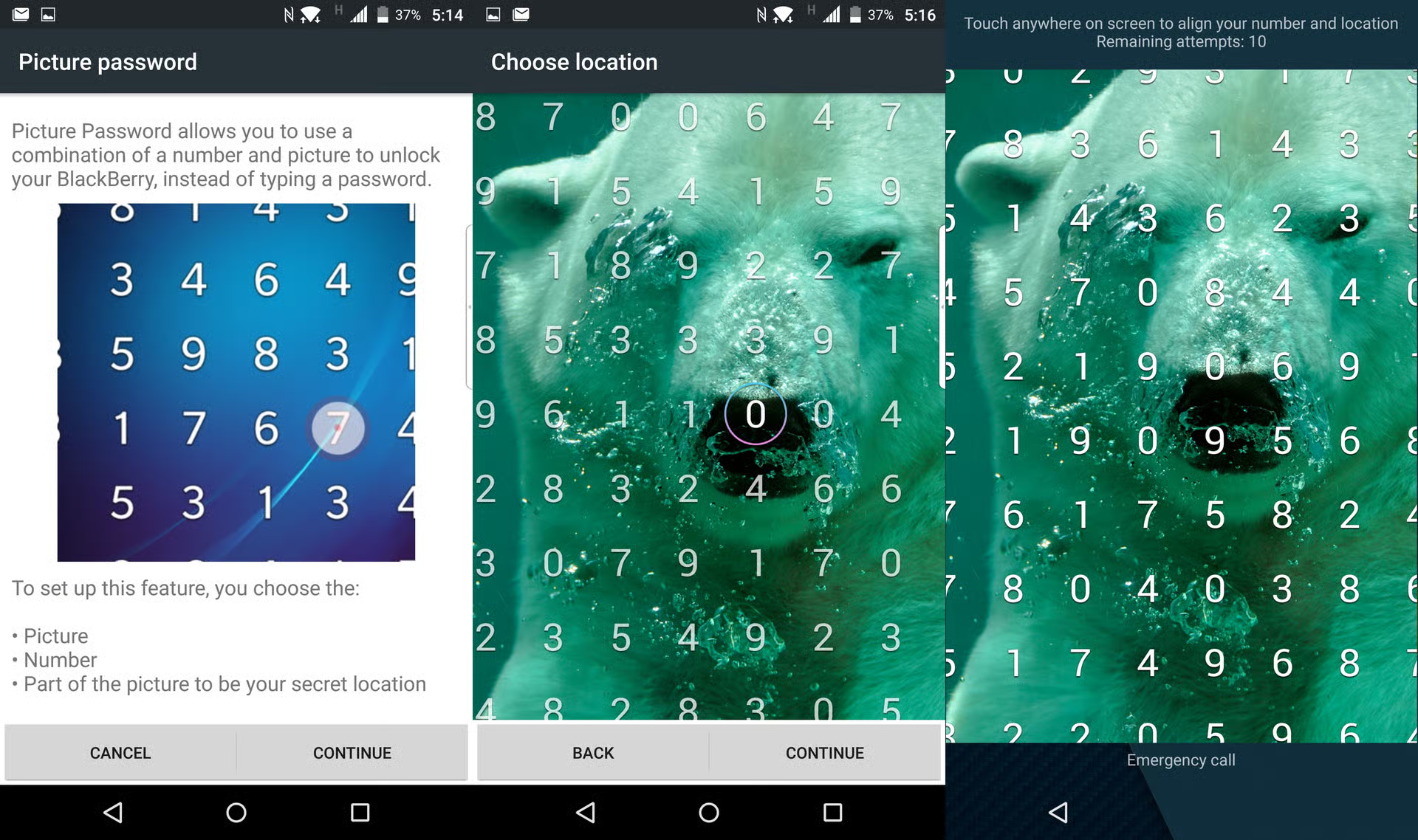
Replying to @ExLisper@lemmy.curiana.net
Make your own contribution to project then.
Replying to @ExLisper@lemmy.curiana.net
Couldn’t a guy with a gun force me to enter my pin?
Replying to @Zedd_Prophecy@lemmy.world
Would police threaten to kill you if you don’t unlock your phone? Not likely. Would they just use your finger and say you agreed to unlock it? More likely.
Replying to @ExLisper@lemmy.curiana.net
Police werent the first people that came to mind. Someone making you unlock your phone to steal your money was what I was thinking. However…
Replying to @Zedd_Prophecy@lemmy.world
Yes, steel pipe to the knee will work equally well against all unlock methods. Graphene OS is supposed to be extra secure to better protect you against tools used by government agencies and law enforcement. It’s used by activists and such. IMHO using fingerprint on Graphene OS makes all this extra security meaningless because police can just force you to unlock and it will be legal:
techtimes.com/…/court-rules-thumbprint-phone-unlo…
Police would not be able to unlock this phone if the guy used pattern unlock.
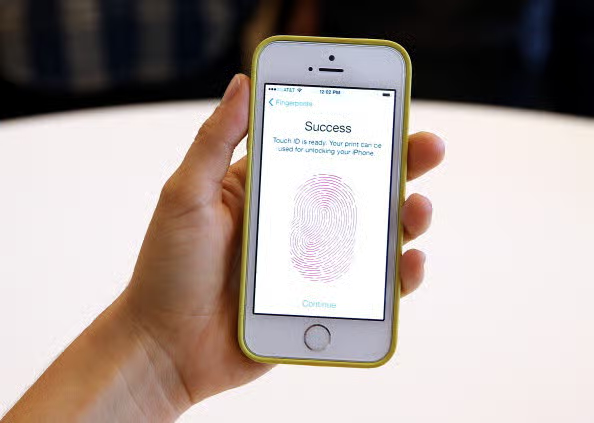 Tech TimesUS Court Rules Police Can Force Suspects to Unlock Phones via ThumbprintThe US Court is now allowing cops to force thumbprint unlocks on your phones if you are a suspect. The US Court of Appeals ruled against defendant Jeremy Travis Payne for his legal team’s appeal to suppress evidence after it was found that police officers forced him to unlock his phone using his
Replying to @ExLisper@lemmy.curiana.net
Would police threaten to kill you if you don’t unlock your phone? Not likely.
“If you don’t enter your PIN in the next 10 seconds we’ll ‘accidentally’ deport your daughter”.
Replying to @Alaknar@sopuli.xyz
Yes, agencies with more power will have more ways to force you. CIA will be able to fly to a dark site and put a car battery to your balls until you give them the PIN. Normal cops during a traffic stop will not have much ways to influence you beyond detaining/arresting you but any cop will be able to take your hand and forcefully place your thumb on a fingerprint reader. And courts say it’s legal.
Replying to @TheTechnician27@lemmy.world
Because the hardware isn’t from google.