posted in Technology

CISA Releases Guidance Urging Water Treatment Facilities to Disconnect Equipment From the Internet

CISA released an urgent message warning water utilities to disconnect their logic controllers from the internet in the face of rising cyberattacks.

The hacks target internet-facing programmable logic controllers (PLCs) that control equipment and allow machinery to communicate. They monitor and control the water pressure, chemical dosing, and other factors to ensure the water is safe.

Many of the PLCs are apparently open to the internet and use default credentials, allowing a remote attacker to easily take them over.

I assume it is this CISA: https://en.wikipedia.org/wiki/Cybersecurity_and_Infrastructure_Security_Agency

www.privacyguides.org/news/2026/07/31/cisa-releases-guidance-urging-water-treatment-facilities-to-disconnect-equipment-from-the-internet/

Privacy GuidesCISA Releases Guidance Urging Water Treatment Facilities to Disconnect Equipment From the InternetCISA released an urgent message warning water utilities to disconnect their logic controllers from the internet in the face of rising cyberattacks.


Replying to @⁨new_otters_raft@piefed.ca⁩

The hacks target internet-facing programmable logic controllers (PLCs)

Why the fuck
is your PLC
facing the fucking internet!

Jesus Zombie Christ an a pogo stick. Has no one been paying attention for the last two decades? Seriously, we learned this sort of lesson in Two Thousand and fucking Three. Your critical assets do not get public IP addresses.

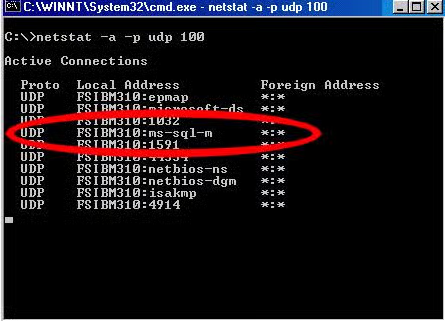
en.wikipedia.orgSQL Slammer - Wikipedia

Replying to @⁨sylver_dragon@lemmy.world⁩

It usually happens in 2 steps.

First step is that everything gets connected to the LAN and you can only access the PLC network from within the building’s network. Then some time later, management finds out that keeping someone on-call to go out costs a fortune, so they request that access be made so they can make the change from anywhere.

The IT team argues security, but no new hardware can be provisioned and a developing a new process is too hard. Then the magical phrase is uttered: “Just make it work”. So IT punches a hole in the firewall, adds a NAT rule, and job done.

Replying to an earlier post

Literally this. It starts with “everything needs to be on an air gapped LAN so we can control it.” And then suddenly that air gapped LAN isn’t air gapped, because someone got tired of paying the call-out fee every time the on-call person had to drive to the site to push a few buttons on a keyboard. But figuring out a proper VPN (or at least a reverse proxy with access control) was too difficult or expensive, (management thinks the point is to save money on call out fees, not spend money on proper hardware) so they just poked a bunch of port-forwarded holes in the firewall and called it a day.

Replying to an earlier post

The issue is doing one at scale, with proper access controls. Also, let’s not skip past the whole “network isn’t air gapped anymore” side of things. Now you’re having to maintain firewalls, patch firmwares, manage users, enforce good password hygiene, etc… All without any additional IT support or hardware, because management is doing this as a cost cutting measure.

I can pretty much guarantee that the systems that get hacked aren’t the ones that do everything right. They’re the ones who have a single shared VPN password, haven’t updated their firewall since it was installed 8 years ago, and they haven’t even changed the default passwords for their control systems. Because they got tired of answering phone calls about what the password was, so they just made every username and password something stupid like admin/admin.

Replying to @⁨Carl@anarchist.nexus⁩

“network isn’t air gapped anymore” side of things. Now you’re having to maintain firewalls, patch firmwares, manage users, enforce good password hygiene,

This is all shit they should be doing now. They have to have a firewall to get to the net, so they should be maintaining and patching it. Managing users is standard AD shit, and password hygiene is t as easy, but setting reqs in AD for complexity goes a long way (as does not forcing passwords to rotate on an arbitrary basis).

And yes, I know it doesn’t happen in a lot of places, which is why I said ‘should’. Having been on the cleanup side of multiple security incidents, doing the basics is harder than you’d expect for a lot of places …

en