The pattern does not stop a camera from recording. Instead, it is designed to prevent the software connected to the camera from recognizing what it sees. A person or car wearing the pattern would still appear in the footage, but the detection system may not flag it as a person or vehicle.
I wonder if these systems won’t “notice” and record the license plate on its own if they don’t think there’s a vehicle present.
More likely is that these companies will just update their models to identify these vehicles once again. Furthermore, patterns like this make the car really stand out from the crowd which is a terrible way to disguise yourself.
Where and under what circumstances? Do you have a link for more information? In my US state, I see reproduced license plates (i.e., not the original state-issued metal ones) all the time. Like stickers, e-paper (I think?), etc.
Benn Jordan did a video on that, he was able to add patterns of stuff to make plates unreadable by ALPR systems. He didn’t share the pattern for people to use as it may be illegal, but you can see it in the video
It’s quite popular tech-related news website. Been around for as long as I can remember and never really noticed anything shady. Not a single filter/AdBlock blocks it on my end.
I took a glance at the list in BadBlock+ and there are a ton of things I’m glad they’re blocking, and a few that I am not. They have grafana.com in there, e.g. I intend to allow sites when needed but will keep the file in use.
This approach only works in daylight with cameras that rely on colour only. Infrared spectrum cameras such as what Australia uses on mobile phone traffic cameras are much harder to deal with. Patterns don’t cut it and it’s a huge part of military research into hiding vehicles from infrared spotters.
Disabling the cameras entirely is much more effective.
Not really. We don’t have materials that absorb or reflect infrared light. It’s one of the reasons it’s hard to beat inferred-guided (heat seeking) missiles, the only real solution is to drop something hotter than your plane, aka a flare.
So… get ready for a new era of commercial automotive flares I guess?
You are mixing different types of IR and on top are wrong for both cases too. We have materials for both NIR and thermal IR that absorb or reflect them.
So if we focus on thermal IR: shiny metal surfaces hardly emit or absorb it. A black surface emits and absorbs as much as possible. We quantify this via the emissivity (and also reflectivity, shiny metal is a mirror). Emissivity of 1 = theoretical maximum of a prefect absorber/emitter (both are directly linked), everyday stuff like skin or wood is about 0.95, shiny metal surfaces roughly 0.1, a rusty or painted surface again about 0.95.
You only emit and absorb the same in thermal equilibrium. If the surface is hotter, it emits more. If it is colder, it absorbs more.
So with that last part, I get that in theory, but practically, you can only really absorb IR temporarily, right? Because it all gets released again as heat eventually. Like, say you have a mostly inert object, that isn’t creating any meaningful amount of heat. If you hit that object with 10 joules of thermal IR, over time, wouldn’t nearly all of that energy be either reflected or emitted off it as IR radiation?
Dumb question I have no idea how infrared light works and cameras. But what if my license plate was just constantly firing infrared light to counter act or “blind” the cameras?
I wonder if those cameras stop working if you have the new IR blocking window tint that keeps the suns heat out but are otherwise clear. Would the camera just not be able to see inside the car at all?
Car enthusiasts seem to get away with alternate plates around me. Sometimes plates from the manufacturer country, sometimes decorative plates resembling the local jurisdiction but being the car’s name or year/model. Either there’s nothing specifically against additional plates that are clearly “novelty” items or my local police just don’t care. Now, if they’re legitimate government-made plates, I’d bet you’d run into issues.
I’m sure you could add something that expands your plate info, but I can’t see a solution that keeps your true plate visible (to avoid direct police activity) without also keeping your actual plate number as part of the character string associated with your vehicle. I do recall reflective letters being sold at one point to defeat standard speed/light cameras (plate is reflective by default, characters are not). But, still, with all the extra details the system logs with y/m/m/c, stickers, attachments, and damage, I regrettably don’t see this being especially effective. But, I suppose, it has a chance to keep your unique vehicle unassociated with government records… For now.
Lol. Those flock cameras must be sending out a recognizable signal, right? Link this to a detector and it could automatically hide your plate when a camera is in range and then flip it back when. You leave range.
At some point people are just going to roll the dice on this bullshit. If they aren’t gonna pay out when they should why are we even paying them? This seems incredibly criminal to deny payment while accepting increasing payments.
If they aren’t gonna pay out when they should why are we even paying them?
Because you can end up losing your car, being fined thousands of dollars, or in jail for driving without insurance. The fact the peasants get no value from it isn’t important, you better keep paying!
The figures don’t mean insurers rejected nearly half of otherwise valid claims. Claims can close without payment because another insurer covered the loss, a customer withdrew the claim, damages fell below the deductible or the loss wasn’t covered by the policy.
You can’t just say this shit and then just dismiss it:
Still, the increase suggests motorists face greater scrutiny when seeking compensation for some of the most complicated and costly types of auto claims.
You don’t need dazzle paint to get hit by a Tesla.
I live in an area where Tesla and Waymo both operate taxis. Waymo is actually pretty solid. Those cars are some of the best, most-predictable drivers on the road. Tesla cabs are meth-addicted clankers.
RF shields already exist, so you could in theory cover the car with it, it could be a problem tho since you can’t really do calls and listen to the radio anymore but i guess you can just put an antenna
I meann, is it necessary? Bluethoot is already weak, i feel like that without covering windshield and windows it wouldn’t be strong enough to be detected outside
It would be simpler to just overlay Bluetooth or RF signals it can read with signals so numerous and strong that it is overwhelmed. The main problem with that is the size of the hardware you'd need.
You could pull the 20 phones in a trench coat thing that one guy did to create "traffic jams" where there were no cars.
My solution so far is a bike rack that blocks my plate from view. Easy enough to feign ignorance and “correct it” in the moment. Flocks database no doubt has an entry for [color][make][model], but at least it’s not associated with me directly through motor vehicle bureau records.
To me, this looks a lot like taking one dose of a prescribed antibiotic. All it really succeeds in doing is training dazzle resistant strains of cameras.
Trying to trick the cameras is playing into an expensive game of cat and mouse. And sure, fine, that may work for a little while, but it’s not a solution.
Looks like Donut Media. A YT car channel I once live that sucks because they sold off to an investment group. And the investment group is really really bad at the content.
It’s a very cool story and Bill Swearingen and I live in the same town, so if anyone’s interested, I opted to make my weekly YT video on this story: https: The NoRecognition Project - Fooling Flock with Adversarial Design.

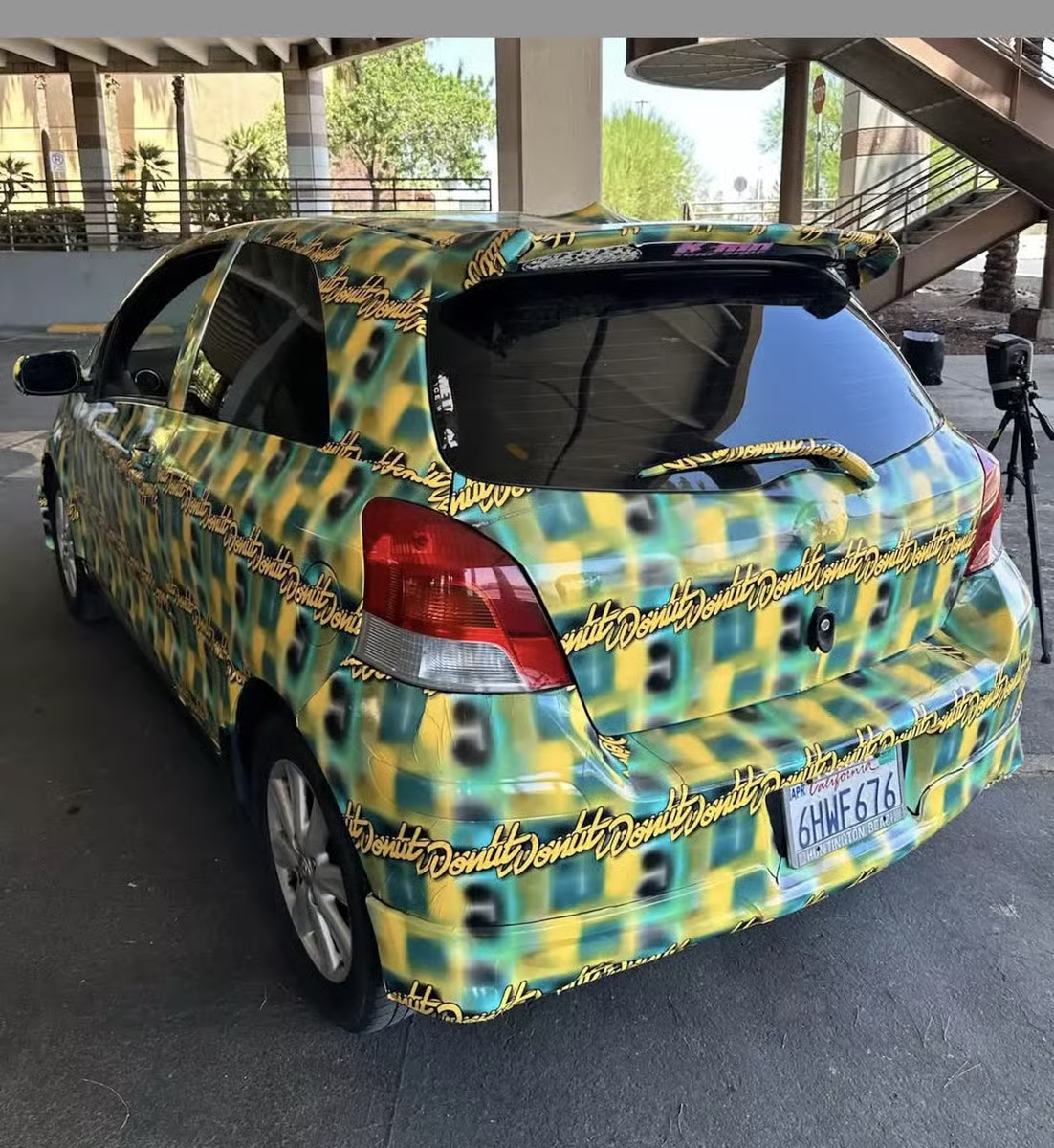 TechSpotA cybersecurity researcher covered a Toyota in an AI-generated pattern to confuse Flock cameras