Starting in the next release, the Bitwarden apps published to the various stores will be the commercially licensed builds. No action is needed, and the apps will work exactly as they do today.
Bitwarden remains committed to open source security and transparency
The GPLv3 OSS licensed version continues to be updated and published on GitHub
All current features are available in both versions
License details are on GitHub
Bitwarden remains committed to a robust, free forever plan for everyone
If you have any questions, please ask them in this thread. Thanks all!
EDIT:
Bitwarden is not going closed-source
You can still fork Bitwarden
No change to self-hosting, the licensing change affects those who are repackaging and reselling Bitwarden
The free plan is here to stay permanently
As always, people overreacting in the comments (of the linked forum). So the current plan is that the core remains OSS, but upcoming features are partially not. To me that sounds similar to Chrome’s or VSCode’s approach.
I’m not saying that’s great news, but it doesn’t sound like the self destruction move that some OSS companies have done recently. I wouldn’t migrate away just because of that change. In the end, they have to find a sustainable mode of operation.
all “current” features. further down its asked about the future and they arent always clear but the fo state there wont be feature parity moving forward
I get it because minio dying burned me hard but so long as it keeps operating as it does now do we need more features? I would be fine with a continuously secure version of exactly what it does now. I kinda hate feature bloat
If it’s not getting security updates and it’s not ona completely airgapped sysyem it’s a huge liability. Especially something that lives at the storage level.
Aren’t there forks being maintained? I was looking at implementing it right before it went enshitty, and I could have sworn there were alternatives…
I meant features on Bitwarden etc. meaning maintenance to me on an app like this is fine. Minio happened too quickly for good alternatives to exist but yes people jumped on getting some together pretty quickly.
It was, if anything, lesson in treating a single FOSS as a solved problem.
Unfortunately, there is no historical example where this hasn’t turned predatory. It’s a tale as old as venture capital has been in software development:
get free contributions from altruistic people donating their time and expertise to your FOSS project that you’re selling
make a closed-source set of extensions as optional dependencies
slowly diverge the closed source feature set to include developer and user “must-haves” you do not contribute upstream
slow or functionally halt open source contributions
It is an oft-repeated long con to pull off a mass heist of donated skill and time while imposing vendor lock-in on your users through a back door.
"As the poison spread through his body, the frog cried out, “Why did you sting me? You have killed us both!”
The scorpion replied, “I couldn’t help it. It’s my nature.”
Split versions is usually the first step. Many projects have done so before. Next year there will be some technical reason they can’t keep feature parity with the commercial repository, and it will drift from the OSS repository. Oops, we broke compatibility, sowwy guys. A couple of years later the OSS repository will be closed because it is a security risk. By that point the company and management would’ve drifted so far from the initial values of the project that people won’t notice. Those who cared will have jumped ship to alternatives sooner, those who noticed later will be already too deep into depending on the software that they will keep paying the subscription.
I have no evidence, but I also don’t have any doubts this is the plan.
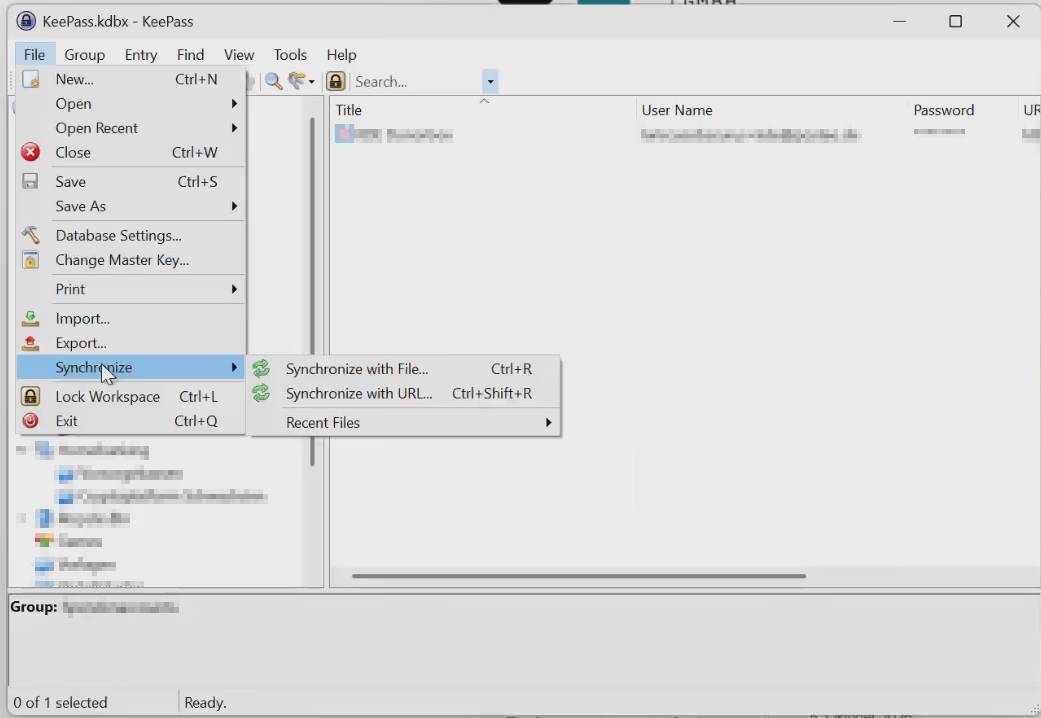
Idk how it compares feature wise, but i have been running keepassxc/keepassdx combined with syncthing (or any file synchronization/cloud system) for many years without issues. The entire password manager database sits in one encrypted .kdbx file that you keep synced between your devices. Syncthing is nice because its p2p, so no self-/hosting required.
I used keepass but switched to vaultwarden, i might consider switching back, but is there a good self hostable web front end for a keepass database? (I need to access it on my work laptop and can’t install stuff there)
There is KeeWeb but I am not sure how well maintained it is. This issue is still open. It might be worth contacting your employers IT department instead. Asking for a well known password manager like KeePass shouldn’t raise any eyebrows.
I’ve been using that for a while. I like the control I have in that I understand where everything is stored and encrypted. I miss the way that Google password manager had the autofill for seemingly every page nailed though.
Every single time Bitwarden is mentioned on the internet, someone comes in here and proudly recites the anthem “I have been using Keep ass with sink things”
It sucks compared to a dedicated extension.
No autofill
No TOTP or 2FA support
Doesn’t do passkeys
Doesn’t have organizational sharing
Doesn’t sync to mobile devices
Doesn’t integrate with mobile browsers without trusting some compatible 3rd party app
Requires selfhosting your passwords (don’t fuck it up!)
It’s actually pretty sad that the open source world doesn’t have a better solution for this.
I mean I guess BitWarden was it but that’s been stolen by venture capital so
Both KeepassXC on desktop and KeepassDX on mobile support autofill, passkeys, and TOTP. Syncing to mobile devices is handled by Syncthing (I use BasicSync on Android) and is quite seamless after setup.
Integration with mobile browsers and other applications is handled by the OS-level autofill service (at least on Android). Trusting a third party app that is completely open source and has a ton of eyes on it? I don’t see a problem with that.
Selfhosting is literally the entire point, since who more can you trust with your most sensitive information than yourself? And even if you don’t trust yourself with being able to keep good backups and following the 3-2-1 rule, you’re more than welcome to sync with a third party cloud provider of your choosing since the password file is fully encrypted.
Why is it that every time i comment about keepass, its because some web based password manager once again broke, got hacked, or stopped development. Keepass users just stay winning :)
Also i have been using keepass with TOTP 2FA for years what are you on about?
Also also, you shouldnt use fido passkeys. Its a failed technology that is worse than what it tries to replace.
I had done that for a long time. It worked until it didn’t and I lost passwords. I tried again with keepass2android and it’s built-in sync. It again worked fine until at some point it wasn’t able to sync anymore for no discernible reason.
I’d love for this to be a reliable setup, but it just isn’t in my experience, at least when there are 3+ devices involved with different clients and no proper awareness of the password manager and the sync sides of each other.
The web interface is hosted directly by your vaultwarden interface so it’s not lockdown-able. The only things that are would be the browser extension and phone apps. Both of which are formally unnecessary because you can always just use the web interface. I’m sure if they ever locked down there’d be community versions in no time as they’re basically just web wrappers anyway.
The apps keep a synced local copy, so if the server is down or unreachable you can still get to your passwords. That can also be locked by biometrics etc.
There’s a lot of stuff that without be lost by going to just the web interface
My knowledge of network security is very limited, right now I only self-host things like movies, music, ROMs, etc. I would love to do the same with my passwords, but I don’t think I would feel comfortable doing it with such sensitive data.
A viable concern if you wanted to put it public-facing. If you only care about syncing when you’re home, though, you should be able to host it perfectly fine just not giving any pathways in from the outside world.
If you wanted to use the Android application, you would have to learn about TLS certificates anyway, because it doesn’t work without HTTPS.
They don’t make any money off of the open source version. It is just a matter of the before they “discontinue” the open source version and move to source available.
If you have any doubts just look at Redis, Vagrant or Terraform
You can watch this same process unfold live before your eyes with Android OS, or if you don’t want to miss the beginning of the show, grab some popcorn and watch these guys.
The current FOSS backend used to be the center of the ecosystem. Going forward that may change. If it stops being that center and it becomes merely a token offering so Bitwarden can claim “we’re still doing FOSS” then it will become pointless.
Simply forking the backend is meaningless without the work to also drag along the entire ecosystem, or establish a new one. Forking a project takes time, effort, vision, persistence, determination.
Both backend and frontend revolve around the API, and Bitwarden owns that not Vaultwarden.
If Bitwarden decides to modify the API so that only their closed-source backend has the full spec, and only gives that spec to their own apps, everything else (Vaultwarden and 3rd-party apps) will fall behind or become unusable.
To counter that, Vaultwarden and the 3rd-party apps need to declare their own API and prepare to fly solo completely independently from Bitwarden.
Such a move would force Bitwarden to show their true colors. If they really mean to stay true to the open version they will keep cooperating and keeping their API in sync with the Vaultwarden API.
If there are two version of Bitwarden backend (closed and FOSS), and the closed one changes its API, and the closed Bitwarden apps also switch to the closed API, then what value does the FOSS API have anymore?
The API is also implemented by the vaultwarden back end.
The open source bitwarden client does talk the current version of this API. The open source client can be forked, so there is without much effort a version speaking this protocol in this version and is FOSS. Just the name will be different. I guess “vaultwarden client” would be fitting, but what ever.
Good question. When you have multiple implementations of an API, the API (the authoritative version) is what gives the reference spec that all other apps must follow.
If the authoritative version will be fully implemented only by the closed backend and in the closed apps, it will cripple the FOSS backend and apps.
This is a common tactic used by companies that want to sideline the FOSS options and slowly make them irrelevant.
Yes, today all apps talk to both Bitwarden and Vaultwarden the same way. Be on the lookout in case that changes.
I’d totally see the risk if the clients were not available as open source. But they are. So I’m not.
They might diverge, but vaultwarden users will just fork. Nobody who is using official clients with vaulwarden will be “oh dang, now I have to buy bitwarden, so long vaulwarden, was fun…”
What differences will exist between the two parallel versions?
Some future components will be published under the commercial license and will exist only in that build. Newly developed features will be evaluated on a case-by-case basis for which license applies to them.
Does anyone know if there’s any chance for a fork before this situation inevitably deteriorates? I dont know the license on that software enough to know if its an option.
No, I have money to pay instead. If I were able to contribute to the effort, I would have said that. Just picking fights in response to open questions today?
It’s a really sad day for me, I love Bitwarden, it’s easily the best password manager I’ve used, and I’m in IT, I’ve used a bunch.
Fuck private equity, fuck it to death. But until then, I’ll be moving my test setup for KeyPassXC into production over the coming weeks and months.
I was happily subscribed to Bitwarden for years for my personal account, I moved several people and a whole company onto it’s platform. We had a good run, time to move on.
It is free and open-source on Desktop at this moment.
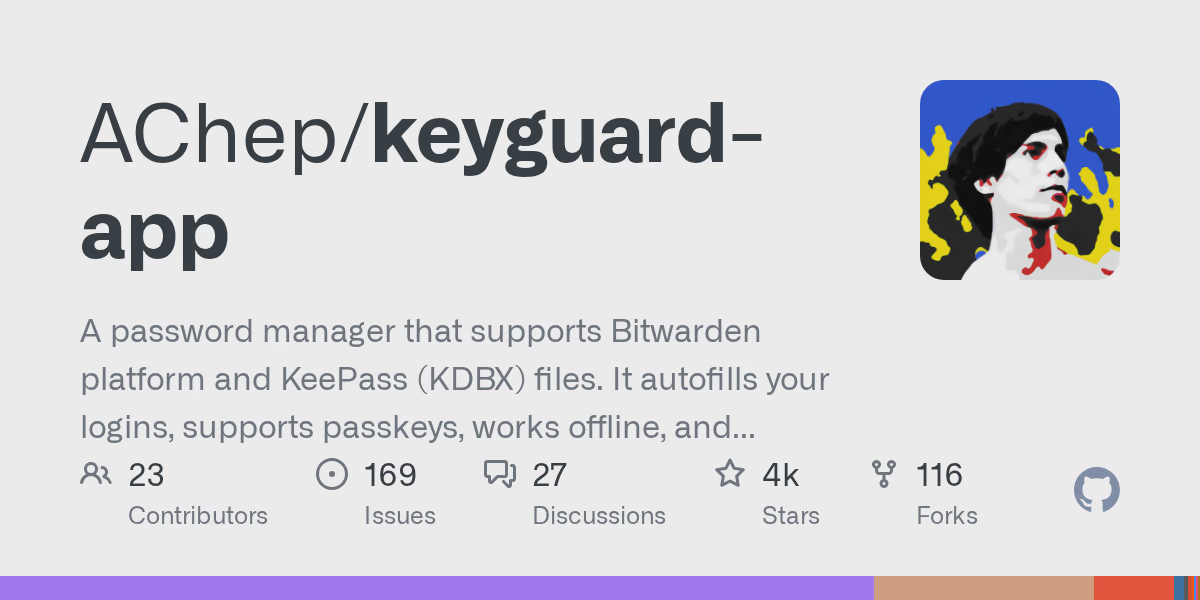
Keyguard is a commercial app and unlocking a premium funds its further development and supports me (Artem Chepurnyi) directly. As of right now, only the Android builds distributed via Google Play store have main features locked behind a paywall, other distribution channels have a build with everything unlocked.
But it makes sense to pay for it, since Bitwarden is a constantly changing system and these projects based on it must always be up-to-date with their API changes, too. This is time and worry consuming, and should be compensated.
Roger that. Thank you for the clarification that you meant the actual term, and not just the fact of no mandatory payment and it having an the source available for public.
I get what you mean, yet frankly, I do not believe such projects may be always free that are supposed to always be up-to-date for another system they have no official relation to, and keep it as a responsible hobby other people depend on.
It currently doesn’t work with Vaultwarden. The Linux client doesn’t accept custom certificates. And the Android client is paid. It is a dead-end for self-hosting.
The license is also stupidly a single sentence. Which means that use could be nuked at any minute, and any money you use to pay the developer means nothing. If they wanted to kill the project today and nuke the repo, you have no legal rights, the project dies and fuck you and your passwords. That doesn’t exactly inspires confidence.
Thank you for pointing out that the license is not FOSS, I hadn’t noticed that. I suppose I’ll be exploring my options again.
I’d been using the Android client from f-droid and hadn’t needed to pay for it, which was working with my VW server. On my desktop/laptop I use rbw, so I hadn’t noticed the cert issues with the kekeyguard desktop client.
Vaultwarden (and all the client apps) depend on Bitwarden for the API spec. If Bitwarden introduces closed features in the API that Vaultwarden can’t/won’t implement, but the client apps do, it will split the spec. They can also introduce API license keys, which would render Vaultwarden mostly irrelevant.
The only way for Vaultwarden to remain relevant going forward is to own it and split ways from Bitwarden. This would in turn mean that the FOSS client apps have to decide which to support. But I think the ecosystem is going to fragment eventually anyway, so the sooner every app decides which way they want to go, the better.
well, the first step of forking is clicking a button or execting a “git clone” command. thats trivial. publishing to android is a bit of work, but very one-time.
keeping up with development is a different story - but many foss projects thrive with support from whoever needs to have something fixed.
You’ll also have to convince other maintainers to adopt the new API in this case, otherwise it’s pointless. Vaultwarden is only the server, you’d at least require one third-party client (e.g. Keyguard) to add and maintain the Vaultwarden API and probably also someone to fork the browser plugins. This whole issue is quite involved.
I highly doubt future compatibility. Things will diverge. I care about having a good hostable password manager. I don’t care about the name of the client or if it’s compatible with some closed source shit.
Sure, it’s no change for self hosters currently, but it’s one more step in moving towards a more closed platform overall. I do hope more FOSS client apps end up getting made sometime soon. I’ve been using Keyguard on Android for some time, which means the recent several breaking changes in the Bitwarden apps to the Vaultwarden backend haven’t hit me as hard, but I do still use the official apps for my laptop and desktop and Keyguard isnt fully FOSS, of course. I’d love to see some forks or brand new apps one of these days that are actually fully FOSS for both mobile and browsers. I’ve thought about doing some myself, but I have too many other projects and I also don’t have a MAC or want to pay the fees to make an iPhone version. And I abandoned my Android Developer account when they started the identity nonsense, so none of my apps are on the official store anymore and Fdroid and similar may not be viable soon, so it would only really be for myself and a few others who use alternate Android OS’s.
@irotsoma There's no such thing as "Actually FOSS" - that's why it stands for Free & Open Source Software.
All of the pain being experienced by this move from Bitwarden is because it is Open Source Software, which is the not-Free, shitty corporate owned version of Free Software.
What you want is software that is "actually Free."
I mean, yeah, that’s what I was saying. I want a truly free and thus FOSS version of the apps. Vaultwarden is a FOSS version of Bitwarden back end, but there aren’t really any totally FOSS apps for it. That’s what I’d like to see more of.
Acronyms, initialisms, abbreviations, contractions, and other phrases which expand to something larger, that I’ve seen in this thread:
Fewer Letters
More Letters
Git
Popular version control system, primarily for code
SSH
Secure Shell for remote terminal access
TLS
Transport Layer Security, supersedes SSL
VPN
Virtual Private Network
4 acronyms in this thread; the most compressed thread commented on today has 6 acronyms.
If self hosting is not an option. Ideas that come to mind:
Evaluate what it is worth to you and maybe pay for it, if they offer enough worth to you and it is affordable.
Then there are people who host it and provide it to others. Together with other apps, as a suite. Maybe that’s an option. But I suppose, donating or paying is expected here, too.
Or switch to another solution. Preferably one with an import feature.
That’s why I’m just using KeePass. It’s just an encrypted file that you can store on whatever storage you want and sync with existing solutions like Syncthing etc.
Yes it’s a bit finicky when you edit the file on multiple devices before they’ve synced but it works very well for me…
All these people keep saying that Vaultwarden won’t work because it relies on bitwarden’s API but if there is an incompatibility then wouldn’t vaultwarden just be left in a functional limbo? Like it’ll still work because self hosted but no more new features in parity with official client? Or have I misunderstood the connection between the two
this year there were 2 separate updates to bitwarden clients that fucked up vaultwarden servers, because the bitwarden developers “accidentally” reused a variable name in the data that was unused for a few years. but vaultwarden forgot to remove it, and now it is used in a different way, and the clients bugged away so hard that you had to uninstall them, because even if you was fortunate to be able to get to your passwords list you could not get it to sync otherwise
and that you have to never deal with sync conflicts. It’s a huge deal for those who are using tech but not understanding it, and a convenience for the rest
Side note: I just tried switching to KeePassXC and it seems pretty fine, except for one caveat. If you installed your browser (probs FF or Librewolf) through flatpak or snap on Linux, the browser extension will not work.
I had to change to the non-Flatpak ver of Librewolf on my Fedora PC, which sucked a little lol 😅
Have you tried fixing it using flatseal and manually changing the config folder location for the browser in keepassxc? Librewolf too, even as native package, requires that location edit
wow, setting up vaultwarden quadlet to work with my selfhosted OIDC sso was stupid easy. Migrating my bitwarden setup to it took no time at all. The extra step was setting up some extra pocketid passkeys to be stored on non-vaultwarden hosted systems (ie. google) to prevent myself from being locked out in case vaultwarden crashes (which probably was a good idea to do regardless). Just need to add the data volume to my regular backup.
I pay for their product and its totally worth. It was $10 for the longest time and much like everything in the last few years has increased price to what it is actually worth. To be honest $20 a year is still stupid cheap and worth it to keep them developing the product. Bitwarden is also one of the few password managers that hasn’t had a user data breach.