posted in Technology

Why BMS Demands More Stable Current Sensing for Lithium DC Power Systems
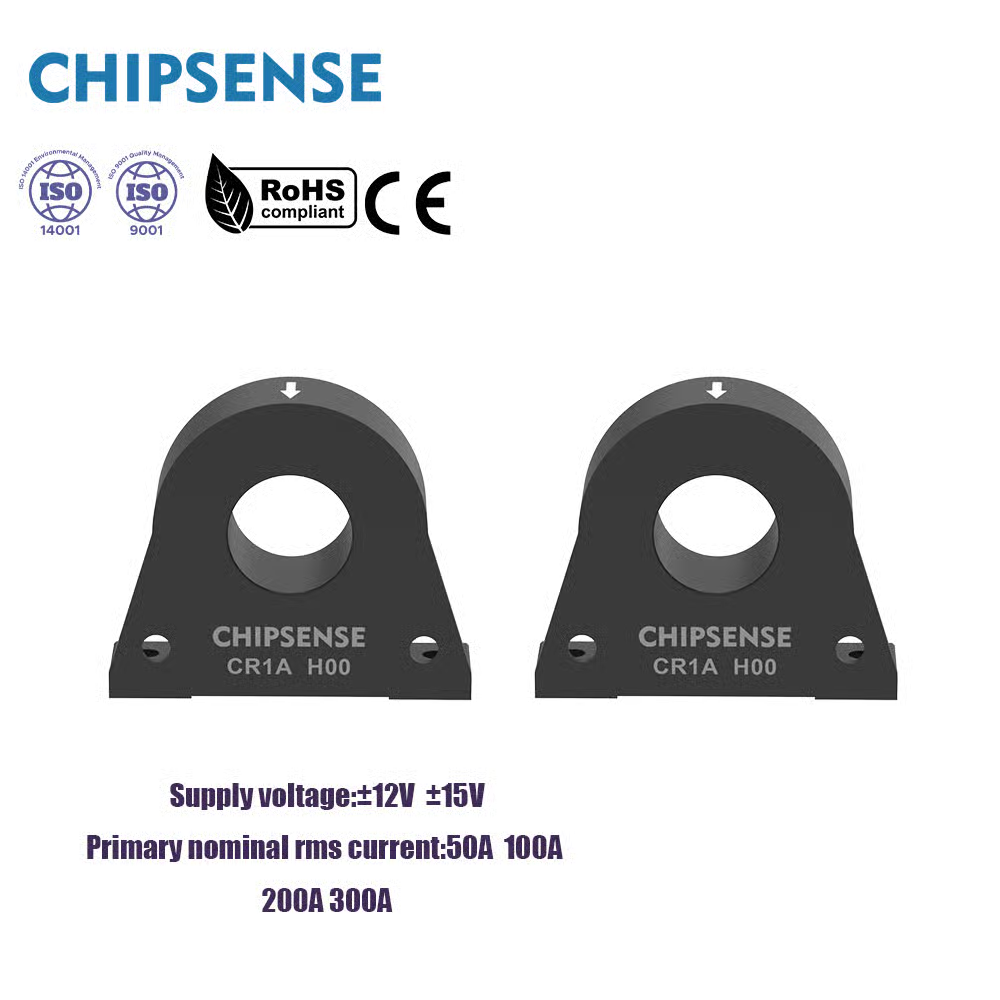
DC backup power systems for substations, data centers and renewable energy sites are gradually replacing traditional lead-acid batteries with lithium iron phosphate (LFP) batteries. This upgrade is far more than a simple battery replacement, as it fundamentally transforms the role of current sensing. Lead-acid systems rely on voltage and floating charge status to judge battery conditions. Current sensors only work for basic data display and fault alerts, with loose standards for long-term precision. However, LFP cells feature a flat voltage plateau across most of their SOC range, making voltage alone unable to accurately reflect remaining capacity. Lithium BMS adopts a combined SOC estimation algorithm built on coulomb counting, where stable current sampling is the core foundation. Minor long-term measurement errors like zero drift and temperature drift will accumulate continuously and severely distort SOC calculation, disrupting charge-discharge control and battery safety protection. Lithium DC power panels adopt two separate current detection positions with differentiated sensor selections. The battery side sensor supports core BMS functions including SOC calculation, so high-precision closed-loop Hall sensors (such as CHIPSENSE CR1A series) are preferred for their low drift and excellent long-term stability. The DC bus side sensor monitors overall system load and abnormal current, where cost-effective open-loop Hall sensors (like HS3V series) can meet regular monitoring demands. In short, current sensing has shifted from a simple monitoring tool in lead-acid systems to a critical control data source for lithium BMS. As smart grids and new energy industries expand, DC power systems will keep raising requirements for current sensors in precision, long-term stability and control integration.