
Dieter Lukas
Investigating the evolution of social behaviour. Comparative Behavioral Ecology group leader (he/him) at the MPI EVA
- Open Science Practices
- https://peercommunityin.org/2020/01/15/submit-your-preregistration-to-peer-community-in-for-peer-review/
- Tips for organizing academic seminars
- https://diversityinacademia.mystrikingly.com/#infographic-academic-seminars
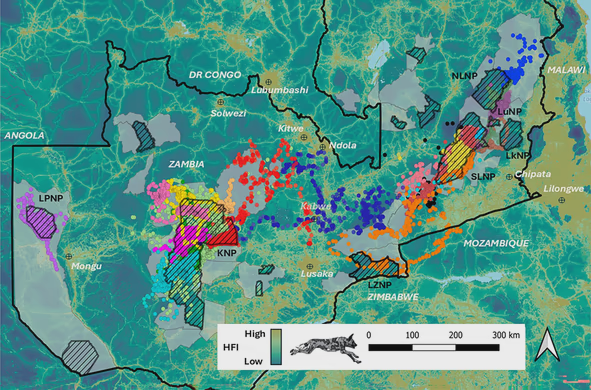
Figure from the article showing the outline of the country of Zambia, with its seven national parks highlighted. Coloured dots indicate the movement of individual wild dogs, showing that they can move across large distances connecting the national parks. The background of the figure is in a colour gradient that indicates the degree of human disturbance, to show that while wild dogs can move through urban areas quickly, they spend more time in less disturbed areas. Figure legend from the article: Movements by African wild dogs dispersing from Zambia's South Luangwa National Park (SLNP) along a protected corridor have connected with North Luangwa (NLNP), Luambe (LuNP), Lukusuzi (LkNP), and Lower Zambezi (LZNP) National Parks. Recently, three males left Kafue National Park (KNP) and moved >2600 km through unprotected areas in the center of the country to connect with four females from SLNP who had moved more than 1500 km, linking the stronghold populations of the Greater Kafue and Luangwa Valley Ecosystems. An unknown wild dog recently immigrated into Liuwa Plains National Park (LPNP) at a time when all individuals (a single pack) were well known. Thus all of the wild dog populations in Zambia remain connected to other populations. Black outline with crosshatch: National Parks. Gray: Game Management Areas, with lower protection than National Parks. The 2020 Human Impact Index (Sanderson et al., 2022) is mapped from low (blues) to high (yellows): Dispersing wild dogs maneuver effectively around areas with high human activity. Wild dog illustration by Bridger Creel, used with permission.