silverpill

@silverpill@mitra.social · Joined ⁨Nov⁩ ⁨2021⁩

Developer of ActivityPub-based micro-blogging and content subscription platform Mitra. I help maintain the FEP repository and write my own FEPs too. Currently working on ActivityPub Next.

Matrix
@silverpill:unredacted.org
$XMR
48YM8jwJqDkeUvD38vepSXFeMZH1zsjbvGwTTuaNSSq6Q5GyeWaeiheAZUsSmNn72YdyLpw8geb4FL3opZfGbguJLUj8Mi9
PGP
0541 49E3 0F91 C6D7 8FFA C49C 955F 5A6E 2123 25F0
OMEMO fingerprint
689a2fb0ec87a9481fb45cb7d8870da6aeb4d8247bd69a39017701133b901f04
Matrix (backup)
@silverpill:poa.st

silverpill boosted

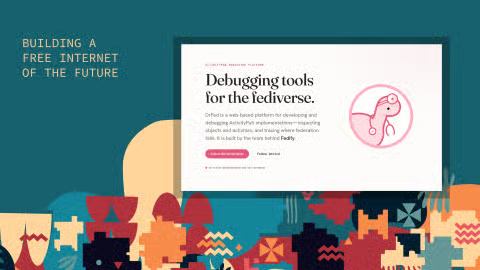
It is an honour to have been interviewed on behalf of the @drfed team for @APC's Building a Free Internet of the Future series.

https://www.apc.org/en/news/drfed-reducing-complexity-and-enabling-more-people-shape-fediverse

Association for Progressive CommunicationsDrFed on reducing complexity and enabling more people to shape the FediverseDrFed is a web-based platform for developing and debugging implementations of ActivityPub – an open standard and protocol for decentralised networking. A team of four people from East Asia is developing DrFed. We interviewed one of them, Hong Minhee, regarding openness, tech, technical specs, the Fediverse’s strengths and limits, language barriers to decentralisation, and far more.

silverpill boosted

Replying to @⁨mitchconner@clubcyberia.co⁩

@Mitch Conner @silverpill Exactly this exists on Hubzilla, (streams) and Forte. With even more options, actually. Hubzilla calls them "privacy groups", (streams) and Forte call them "access lists".

Now it comes: You can not only post to one specific such group/list. You can also post to several ones. Or to any combination of privacy groups/access lists and single contacts.

Better yet: You can even exclude single contacts or the members of certain privacy groups/access lists. You can post to the members of privacy groups Foo and Bar, except if they're also in privacy group Baz, and except for Alice, and in addition, you can post to Bob and Carol.

In addition, Hubzilla, (streams) and Forte don't just define who receives the post. They don't simply flag it a DM either. They flag it "restricted" and only grant the recipients permission to read the post, read any comments and interact with anything in the conversation. In practice, this also means that those who have these permissions can not only interact with the original poster, but just as well with each other, because it isn't a DM.

Anything that doesn't understand these permissions, e.g. Mastodon, do understand it as a DM. This limits their possibilities to interact, but it's the safe way.

And yet, Hubzilla, (streams) and Forte still have private and/or secret groups with moderation (like Facebook groups) on top of all this. (streams) and Forte even optionally have two levels of non-moderator users.

#Long #LongPost #CWLong #CWLongPost #FediMeta #FediverseMeta #CWFediMeta #CWFediverseMeta #Hubzilla #Streams #(streams) #Forte #Groups #FediGroups #FediverseGroups #PrivateGroups #Permissions #PrivacyGroups #AccessLists
hub.netzgemeinde.euNetzgemeinde/Hubzilla

Private groups

Lately, I've been seeing various people claiming that fediverse doesn't have private groups. They often point to some task force at w3c that is supposedly working to fill the gap.

However, fediverse has had private groups for a very long time:

- Hubzilla channels. This project probably had private groups before ActivityPub. The implementation was later adapted for ActivityPub and refined in subsequent forks, Streams and Forte. It is now partially documented in FEP-171b: Conversation Containers.
- Smithereen groups. This implementation is documented in FEP-400e: Publicly-appendable ActivityPub collections (published in 2021) and FEP-db0e: Authentication mechanism for non-public groups.
- Lemmy communities. Private groups were proposed in Lemmy RFC 0005 and have been implemented in the development version. There is a test instance running this version (Lemmy v1.0b) at https://voyager.lemmy.ml/

There are probably other implementations that I am not aware of.

#Hubzilla #Smithereen #Lemmy

info.hubzilla.huGroups / Forums / Communities - en - Hubzilla KnowledgeDB

silverpill boosted

FEP-2345: fediverse:creator

Hello! First time submitting a FEP myself. This one is for a feature Mastodon has had since July 2024, which is fairly popular among bloggers and journalists.

Often, the author of a website is present on the social media platform where the links to the website are being shared. However, usually there is no quick way to navigate to the author's social media profile from the link preview. Being able to navigate to the social media profile of a website's author from that website's link preview is a win-win situation for the author and for the platform. This FEP defines a new meta property fediverse:creator which can appear in the section of any website.

PR: https://codeberg.org/fediverse/fep/pulls/893

Mastodon BlogHighlighting journalism on MastodonToday we're launching a new feature that will highlight writers and journalists that are active on the fediverse when their articles are being shared.

Replying to @⁨panos@catodon.rocks⁩

@panos What do you mean by proper group federation?

In my experience, group federation works well in Discourse. Most of the bugs that we identified during the test drive at SocialHub have been fixed.

I can name only one major issue that still remains, incorrect timestamps in old threads: https://meta.discourse.org/t/activitypub-plugin/266794/487

Discourse MetaActivityPub PluginHi, I’m trying to report an issue with the AP plugin regarding the published datetime being incorrect on posts that are manually “published” via the “Publish all posts” button. Example https://browser.pub/https://socialhub.activitypub.rocks/ap/object/a8d6c23e6c428313efb9bf20efeb020c Expected behavior published indicates the datetime the post was originally published, i.e. the datetime visible locally in Discourse (2018). Actual behavior published indicates the date the AP resource was created...

Replying to @⁨silverpill@mitra.social⁩

@sun @deutrino

>can you tell me more about where I can read about your work with p2p and your idea for adapting forgefed? I'm interested.

1. My experiment with ActivityPub over Syncthing: https://mitra.social/post/019de9a2-7769-7713-85c9-ad8e8599268d
2. ActivityPub & iroh: https://mitra.social/post/019f8116-59de-71f2-8c56-2e87e32c2859
3. I'm currently working on federated groups in Mitra and so far they seem to be compatible with FEP-ef61 and therefore with P2P ActivityPub
4. ForgeFed has many similarities with federated groups: https://codeberg.org/ForgeFed/ForgeFed/issues/324

Mitra ZeroFediverse & P2P - Post by @silverpillFediverse & P2P - Post by @silverpill

Replying to @⁨sun@shitposter.world⁩

@sun @deutrino

Radicle had some ties to Ethereum ecosystem since the beginning, that's how I discovered them. Initially there was no token or anything like that, they just wanted to use Ethereum as a payment layer.

But at some point this happened: https://web.archive.org/web/20211218051828/https://radicle.xyz/blog/introducing-rad.html

The token sale was followed by the usual enshittification you're probably familiar with. At some point I stopped paying attention to this project, only to discover it again around 2025. The price of RAD token went to nearly zero and now they are pretending that they have nothing to do with it.

This may seem like a small thing, but I believe that this kind of behavior did a lot of harm to the crypto community and should not be tolerated.

web.archive.orgRadicle Blog - Introducing RADThe Radicle project has released its native governance token, making it the first open-source, community-led, and self-sustaining network for software collaboration. The Radicle token is live! The official contract address is …