Astronomy Picture of the Day

Bot

@apod@reentry.codl.fr · Created ⁨Nov⁩ ⁨2024⁩

Discover the cosmos! A different image of our fascinating universe every day.

🌌 https://apod.nasa.gov/

Formerly @APoD, 2018 - 2024

Something broke?
Please ping @codl or email codl@codl.fr
Code (currently not in use, posts manually edited)
https://codeberg.org/codl/mastodon-apod

Contemplating the Sun
Image Credit & Copyright: Steven Gilbert

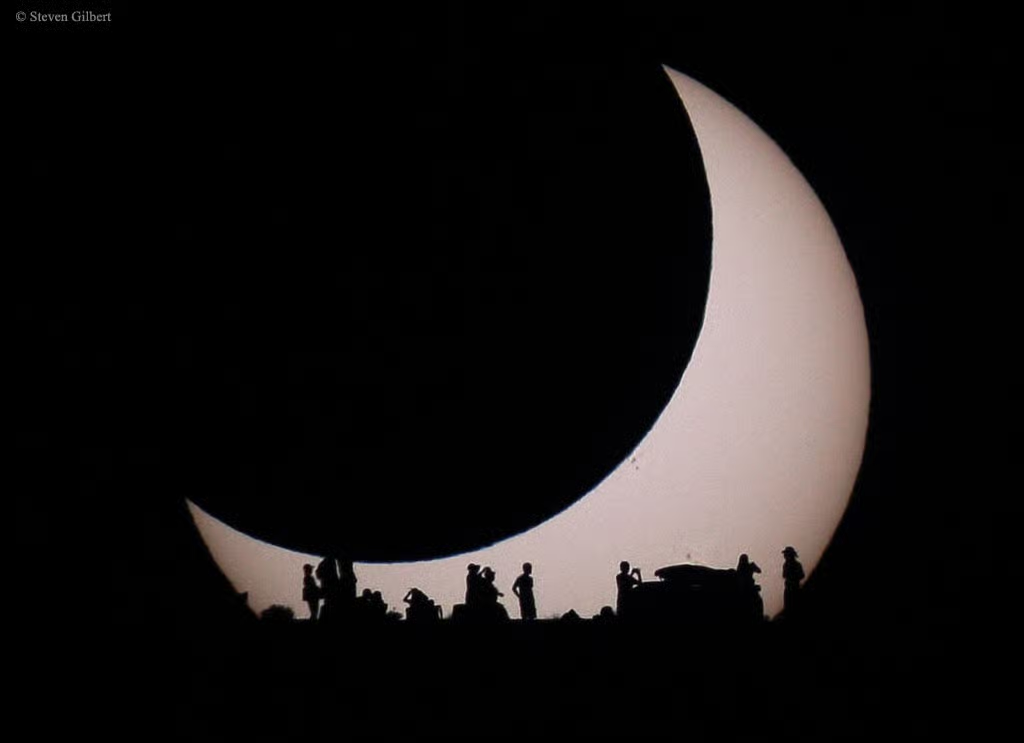
Explanation: Have you contemplated your home star recently? Featured here, a Sun partially eclipsed on the top left by the Moon is also seen eclipsed by earthlings contemplating the eclipse below. This spectacular menagerie of silhouettes was taken in 2012 from the Glen Canyon National Recreation Area near Page, Arizona, USA, where park rangers and astronomers expounded on the unusual event to interested gatherers. Also, faintly visible on the Sun's disk, just to the lower right of the dark Moon's disk, is a group of sunspots. A new solar eclipse will occur this week and give many people in northern North America, Europe, and northwestern Africa a new chance to contemplate a partially eclipsed Sun. A thin swath of Earth through Greenland and Spain will further experience a total solar eclipse. An open question is whether any meteors from the peaking Perseids will be visible during totality.
https://apod.nasa.gov/apod/ap260809.html #apod

A light disk is visible on the lower left but the rest of the disk is eclipsed by a darker disk of the same apparent size. At the bottom of the image are the silhouettes of several people.
ALT

New Sharpest Image of the Sun Uncovers Instability
Image Credit: NSF, NSO, AURA, MPS, Inouye Tel.

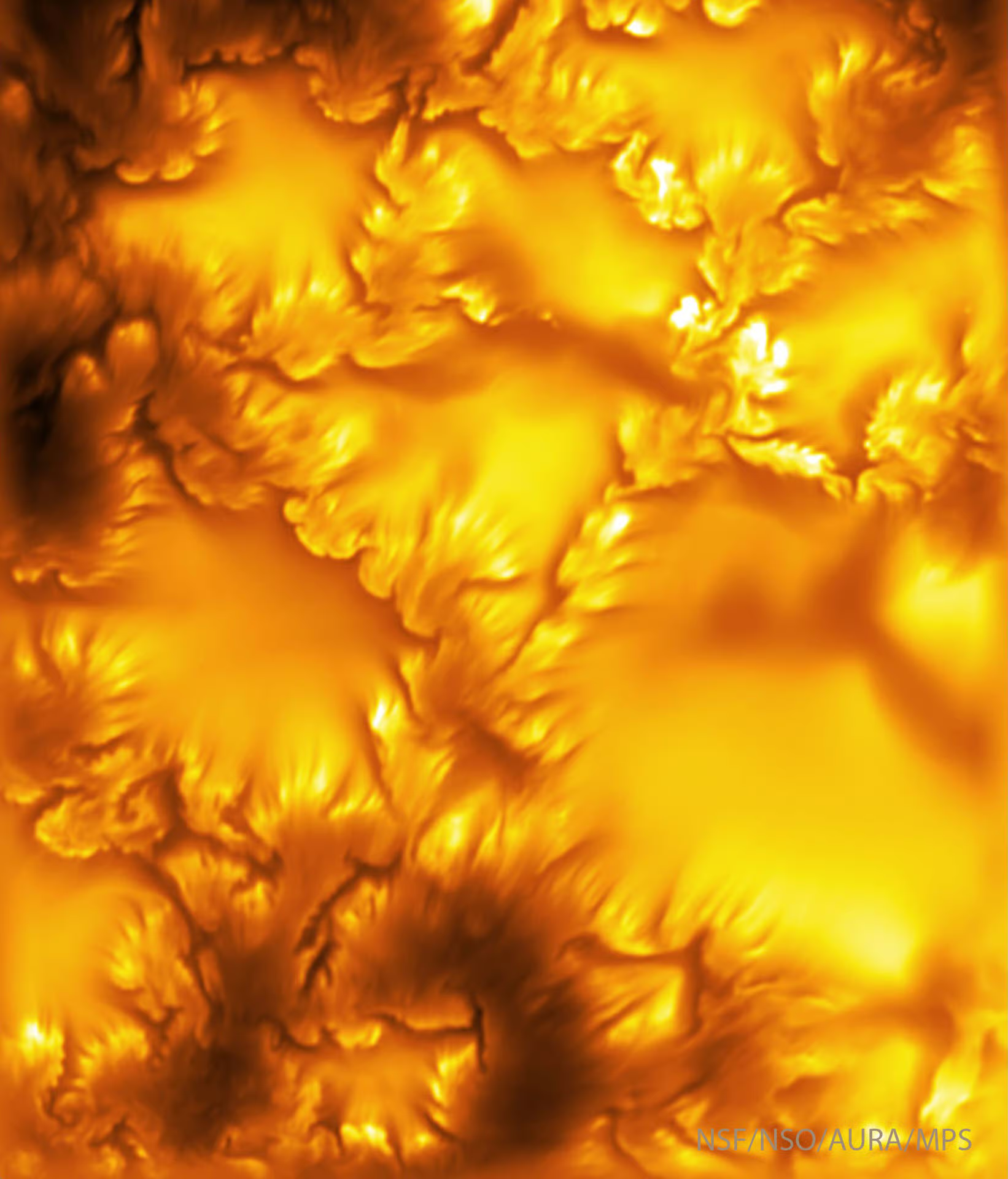
Explanation: What does the new sharpest image of our Sun show? Instability. To be clear, a certain kind of interactive process called the Kelvin-Helmholtz instability (KHI). This instability can create waves and swirls when two streams flow past each other -- in this case variable streams of solar magnetic plasma. Long hypothesized to occur on the Sun's surface, KHI streaks and swirls were confirmed in just-released dramatic high-resolution images taken recently by the Inouye Solar Telescope in Hawaii, USA.  The featured false-yellow image, actually taken in deep blue, is the highest resolution image yet of the Sun in visible light. It spans about the radius of the Earth, but its finest details are city sized. Visible are several smooth tops of changing solar granules, while the edges of the flower-like structures have been found to harbor multiple KHI swirls. Future research may investigate how the KHI helps move energy, magnetic fields, and may even heat the surrounding solar corona.

https://apod.nasa.gov/apod/ap260806.html #apod

A image shows flowery dark and light structures on a yellow background.
ALT

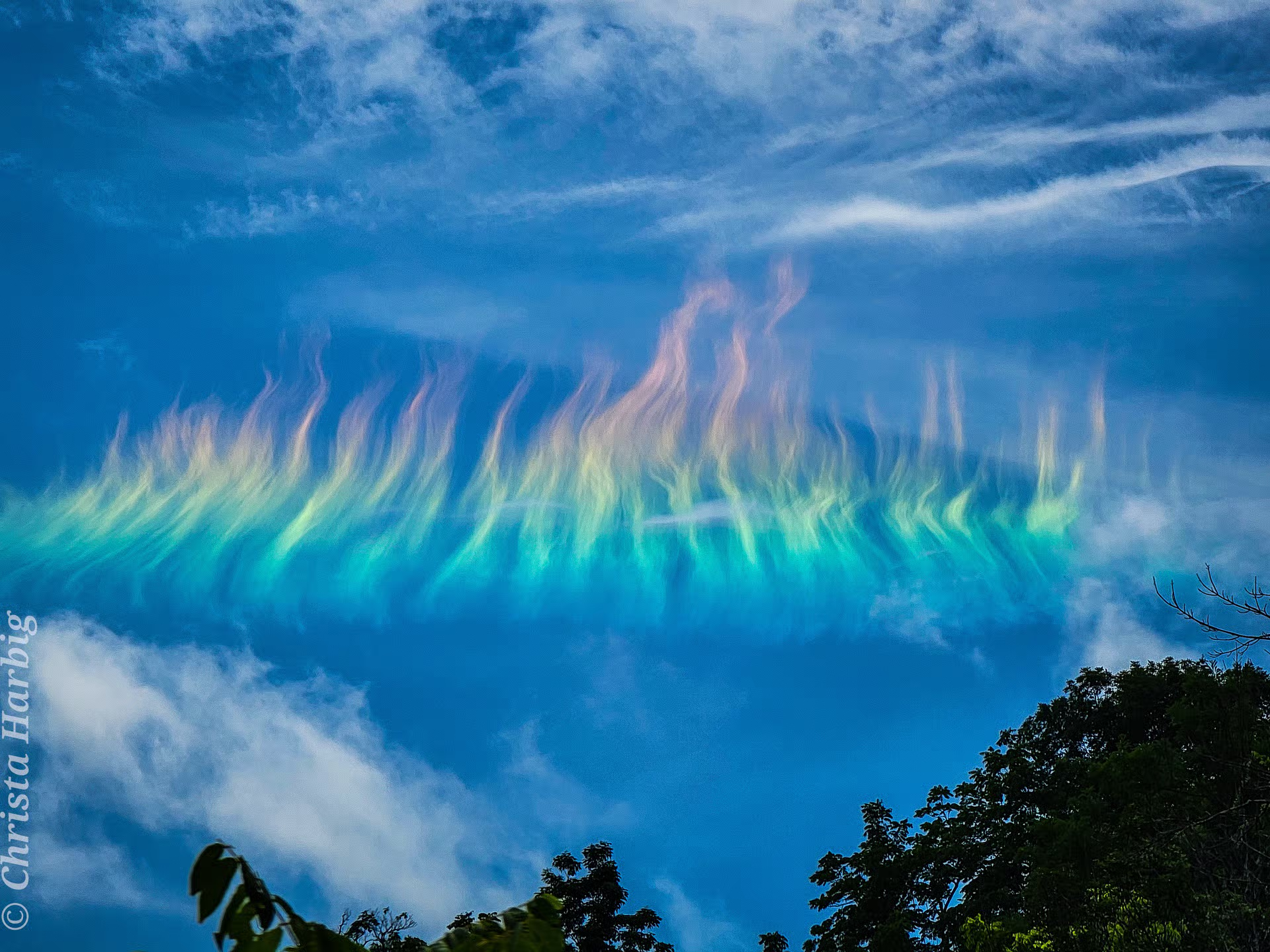
A Fire Rainbow over West Virginia
Image Credit & Copyright: Christa Harbig

Explanation: What's happening to this cloud? Ice crystals in a distant cirrus cloud are acting like little floating prisms. Known informally as a fire rainbow for its flame-like appearance, a circumhorizon arc appears parallel to the horizon. For a circumhorizontal arc to be visible, the Sun must be at least 58 degrees high in a sky where cirrus clouds present below -- in this case cirrus fibratus. The numerous, flat, hexagonal ice-crystals that compose the cirrus cloud must be aligned horizontally to properly refract sunlight in a collectively similar manner. Therefore, circumhorizontal arcs are somewhat unusual to see. The featured fire rainbow was photographed in 2021 near North Fork Mountain in West Virginia, USA.

https://apod.nasa.gov/apod/ap260802.html #apod

Blue sky has white clouds across the top and dark tree tops across the bottom. Across the middle is a very colorful row of clouds that are wavy and are orange at the top and green at the bottom.
ALT

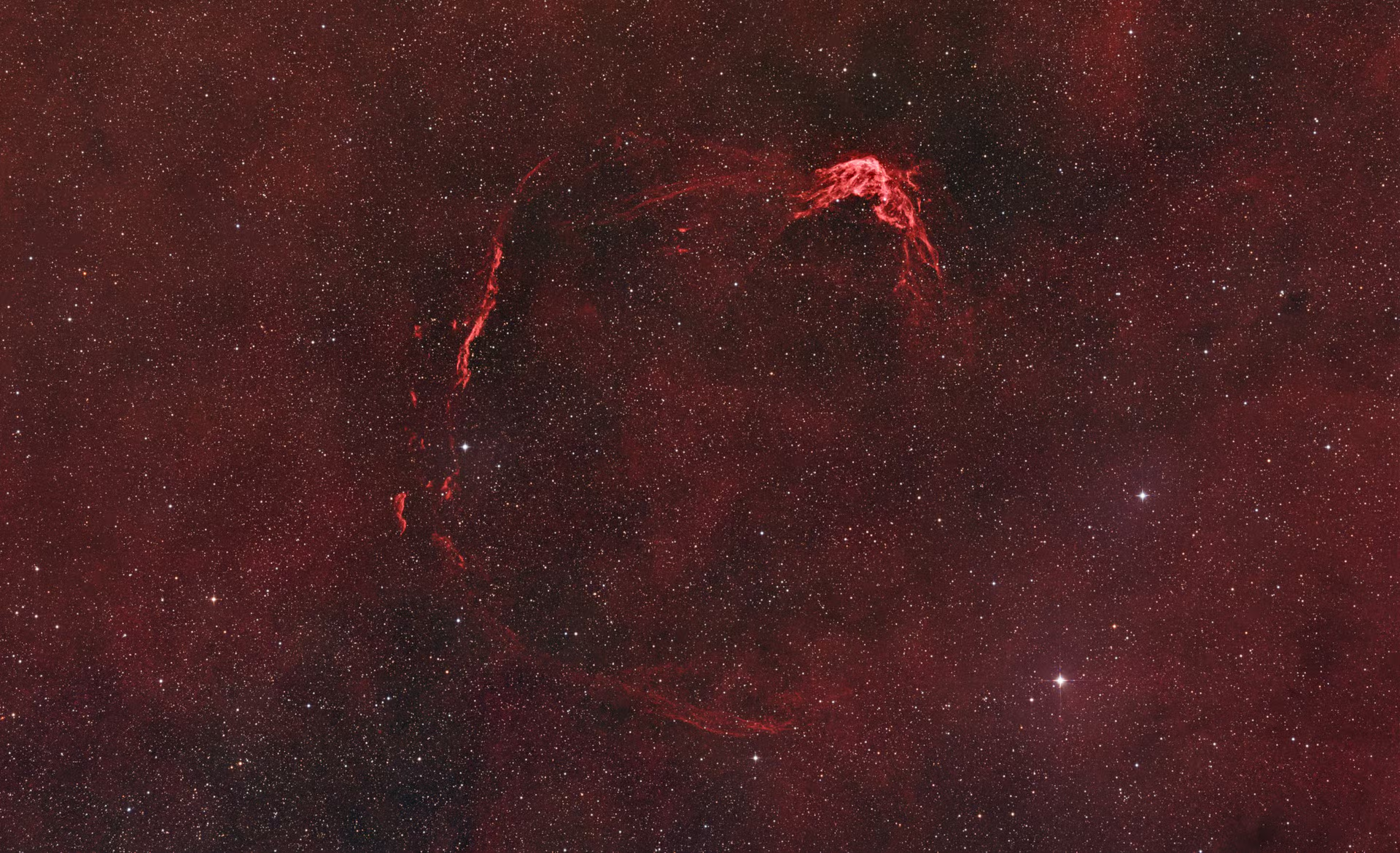
RCW 86: Historical Supernova Remnant
Image Credit & Copyright: David Cowland

Explanation: In 185 AD, Chinese astronomers recorded the appearance of a new star in the Nanmen asterism. That part of the sky is identified with part of the southern constellation Centaurus on modern star charts. In fact, the new star was reported to be visible to the naked eye for months before it faded from view, and is now thought to be the earliest recorded supernova. In this 21st century telescopic image, the wispy outlines of a faint emission nebula recognized as the remnant of that historical stellar explosion can be traced against a starry background. The ragged but roughly circular extent of the nebula, cataloged as RCW 86, represents interstellar gas ionized by the supernova's still expanding shock wave. Space-based images indicate an abundance of the element iron in RCW 86 and the absence of a neutron star or pulsar within the remnant, suggesting that the original supernova was Type Ia. Unlike the core collapse supernova explosion of a massive star, a Type Ia supernova is a thermonuclear detonation on a white dwarf star that has accreted material from its companion in a binary star system. Near the plane of our Milky Way galaxy and larger than the full moon on the sky this supernova remnant is too faint to be seen by eye though. RCW 86 is some 8,000 light-years distant and around 100 light-years across.

https://apod.nasa.gov/apod/ap260724.html #apod

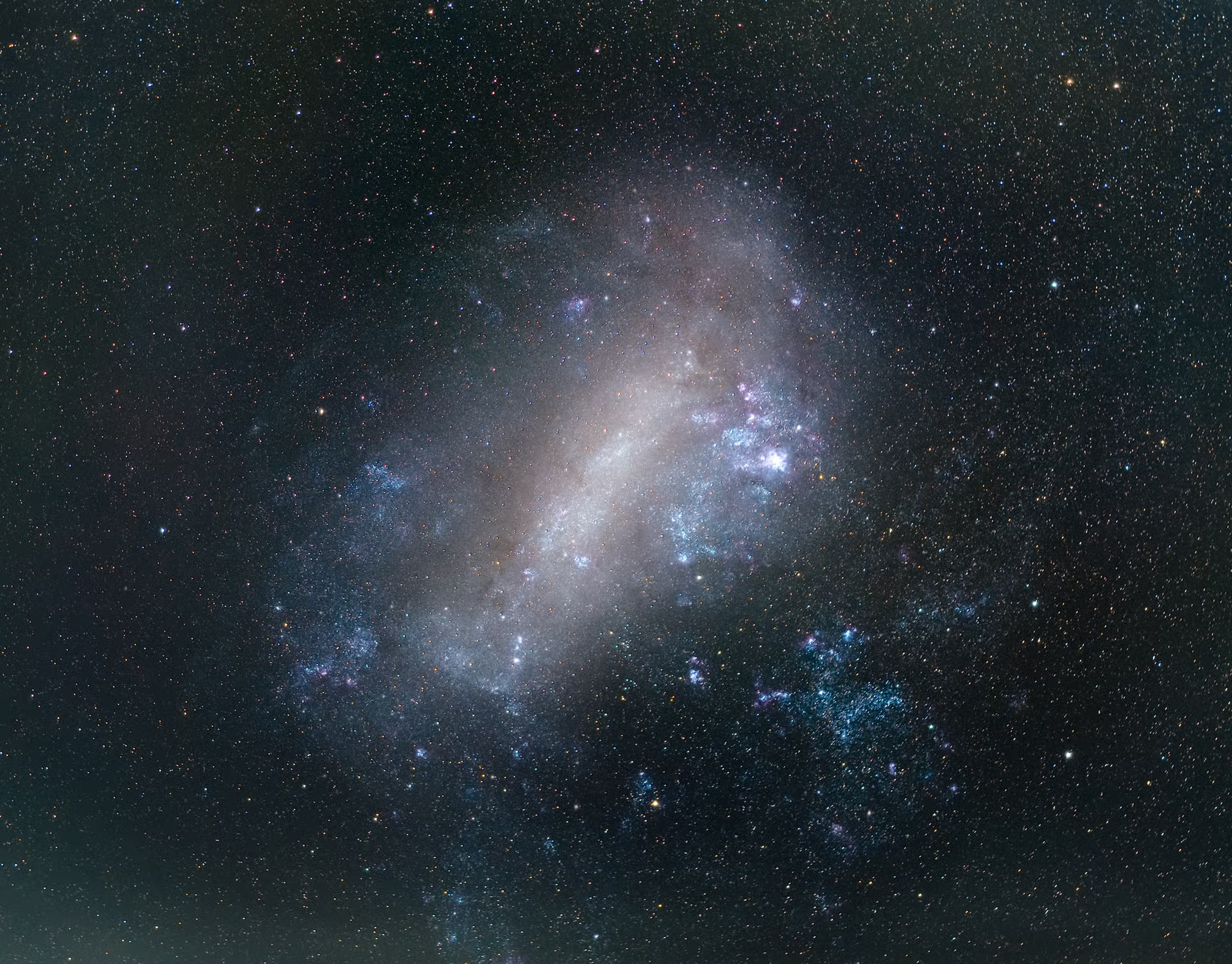
The Large Magellanic Cloud
Image Credit & Copyright: Monica Mesa
Text: Cecilia Chirenti (NASA GSFC, UMCP, CRESST II)

Explanation: Have you ever seen another galaxy with your own eyes? The featured image shows the Large Magellanic Cloud (LMC), one of the closest neighbors of our Milky Way. If you are anywhere south of latitude 20° N (but the further south, the better), you can see it with the unaided eye if you go to a dark sky location, away from big cities and light polution. It is a dwarf irregular galaxy about 163,000 light-years away, and a member of our Local Group of galaxies. Despite being small, with a total mass approximately equivalent to 10% - 20% of the mass of the Milky Way, the LMC is very actively forming stars. This is likely due in part to the gravitational push and pull of tides caused by the Milky Way on the LMC. Some astronomers have predicted that it will collide with the Milky Way in in about 2 billion years.

https://apod.nasa.gov/apod/ap260723.html #apod

A galaxy with stars and colorful clous of gas. The background is a dark field of stars.
ALT

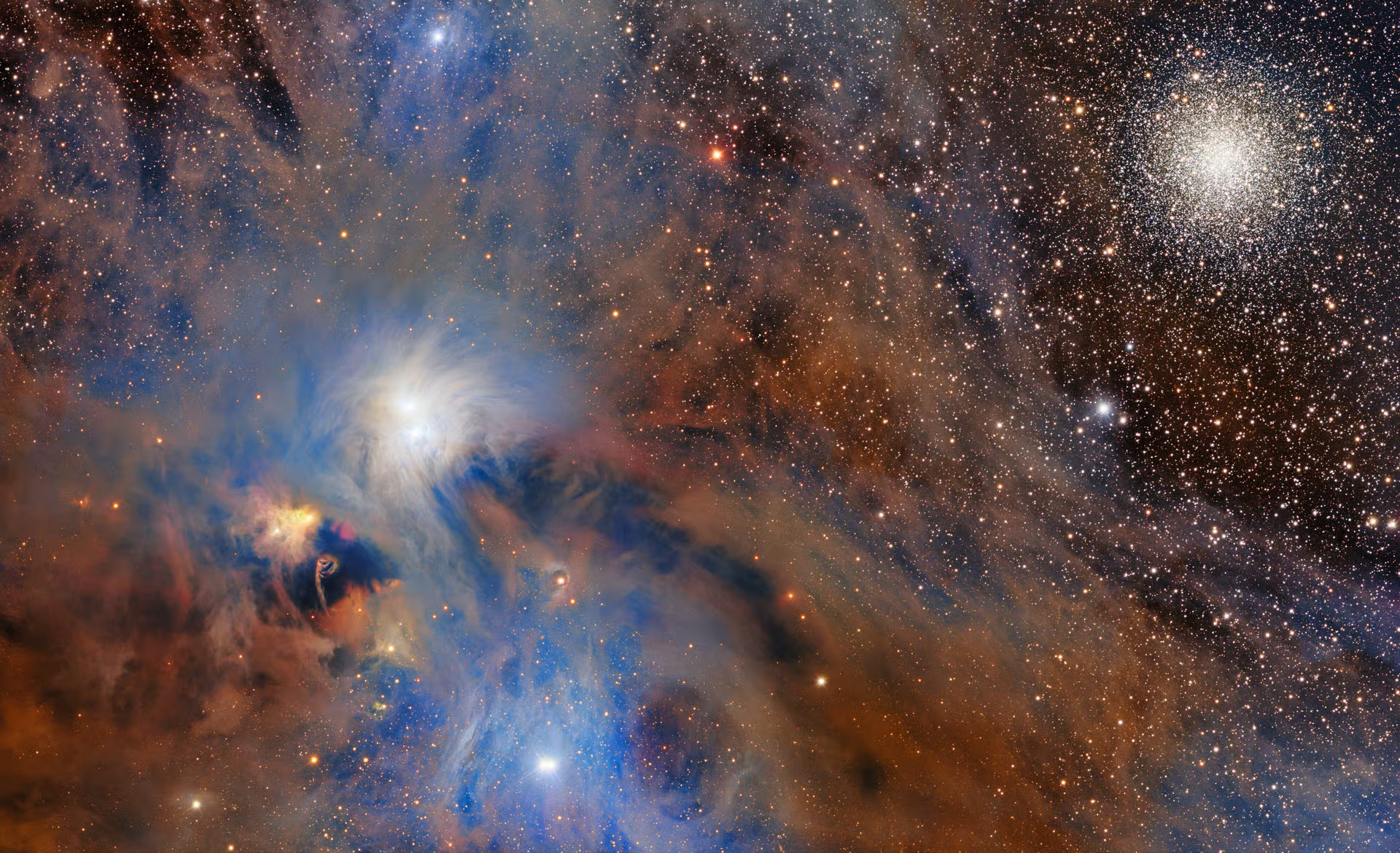
The Corona Australis Molecular Cloud and the Chandelier Cluster
Image Credit: DES/DOE/FNAL/DECam/CTIO/NOIRLab/NSF/AURA
Image Processing: T.A. Rector (UAA/NOIRLab), R. Colombari & M. Zamani (NOIRLab)
Text: Keighley Rockcliffe (NASA GSFC, UMBC CSST, CRESST II)

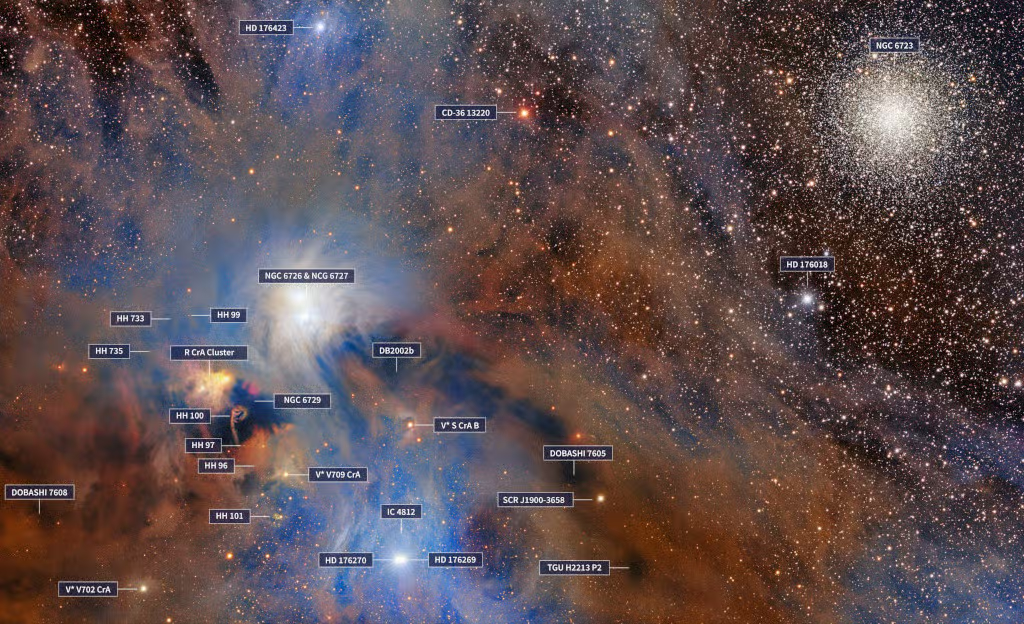
Explanation: The Southern Crown (Corona Australis) dazzles with young and ancient celestial jewels. The Corona Australis Cloud is a collage of reflection and emission nebulae on the left of today’s image. At 430 light years away, this cloud is one of the closest star-forming regions to Earth. It contains gas cool enough (-260 Celsius or -440 Fahrenheit) to collapse into protostars. Recently formed stars paint blue hues across the cloud as their light reflects off surrounding material. The waltz of the R Coronae Australis binary system stirs up the nebula NGC 6729. The younger of the pair ionizes nearby gas with its ultraviolet light, causing it to glow. The Chandelier Cluster (NGC 6723) dangles from the top right, but is actually tens of thousands of light years farther away than its apparent star-forming neighbor. While NGC 6723 experienced multiple periods of star formation creating slightly younger stars, the chandelier twinkles with stars almost as old as the universe.

https://apod.nasa.gov/apod/ap260722.html #apod

Both dense and whispy clouds streak across the left side of the image with bright stars peaking through. A few stars stand out as brighter than the rest. A tight cluster of stars sits to the top right of the image. The background is covered with stars.
ALT