← Back to post

Edit history

Most recent

I have to admit, Lemmy is so politically uniform that I kinda welcome something else.

Question: how do libertarian capitalists expect to combat corporatism? If anything, capital has a tendency to grow or die, and economies of scale along with vertical integration dictate higher survivability and profits of larger businesses vs smaller. And so, corporate structures appear again. What can be used to prevent it?

Also, if you allow me to comment on some of the key points raised…

The rich get richer, but the poor also get richer

One of the most common criticisms of late-stage capitalism is exactly that poor do not get richer anymore.

For example, here are nominal and inflation-adjusted median household incomes in the US: 3245
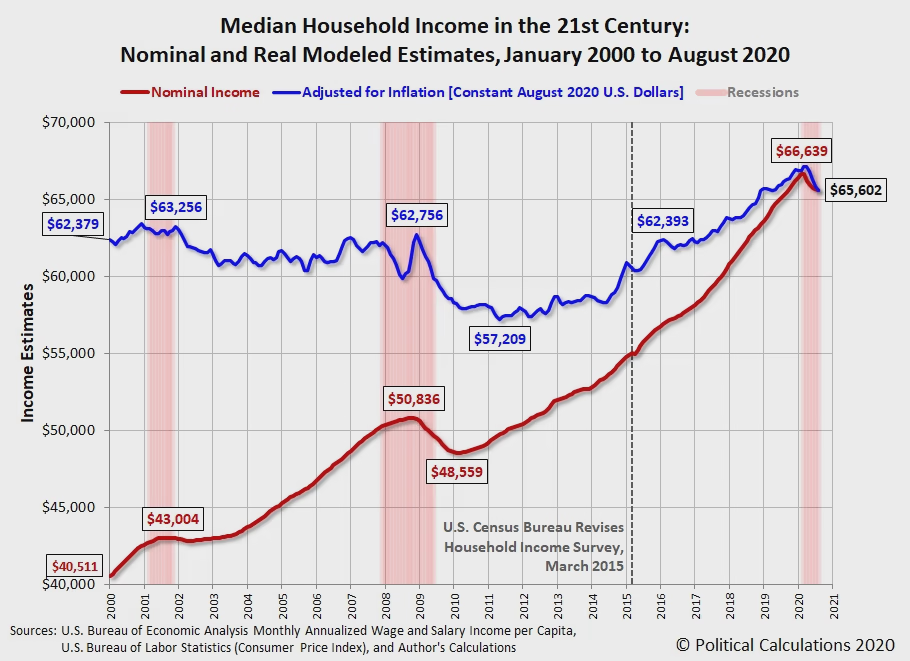
Considering that inflation metrics count the whole economy, and not particularly basics like housing (which went through the roof and yet accounts for a huge share of expenses in a median and especially poor household), it’s not unreasonable to assume poor people are worse off than they were 20 years before.

Prices being allowed to move through supply and demand, rather than being set by central planners, are necessary for the efficient allocation of scarce resources to their most needed ends.

The socialist criticism is that “most profitable” and “most needed” are two different things. Suppose you made a meal, and offer it to a millionaire and a broke homeless individual. Most likely, the latter will need it more, but won’t be able to pay for it as much as the former.

We see China’s economy dramatically advance by switching to an overwhelmingly capitalist mode of production

And we see USSR economy skyrocketing after socialists came to power. And yes, extreme growth went way beyond New Economic Policy.

What we need to look for here, if we must be honest, is externalities. China switching to a more capitalist mode was net benefit because it enabled global trade as opposed to relative economic isolation. One of the main issues dragging socialist economies behind was that, being formed mostly of a few countries tilted into extreme poverty by previous regimes, they never got to access the same volume of trade and capital investment as their capitalist counterparts. When even these markets started to crumble through the Cold War, China had little other options.

USSR, on the other end, started on a low enough point that first advancements were relatively easy and investments paid off rather quickly. And, of course, there’s gulag, too.
3245
Edited

I have to admit, Lemmy is so politically uniform that I kinda welcome something else.

Question: how do libertarian capitalists expect to combat corporatism? If anything, capital has a tendency to grow or die, and economies of scale along with vertical integration dictate higher survivability and profits of larger businesses vs smaller. And so, corporate structures appear again. What can be used to prevent it?

The rich get richer, but the poor also get richer

One of the most common criticisms of late-stage capitalism is exactly that poor do not get richer anymore.

For example, here are nominal and inflation-adjusted median household incomes in the US: 3245

Considering that inflation metrics count the whole economy, and not particularly basics like housing (which went through the roof and yet accounts for a huge share of expenses in a median and especially poor household), it’s not unreasonable to assume poor people are worse off than they were 20 years before.

Prices being allowed to move through supply and demand, rather than being set by central planners, are necessary for the efficient allocation of scarce resources to their most needed ends.

The socialist criticism is that “most profitable” and “most needed” are two different things. Suppose you made a meal, and offer it to a millionaire and a broke homeless individual. Most likely, the latter will need it more, but won’t be able to pay for it as much as the former.

We see China’s economy dramatically advance by switching to an overwhelmingly capitalist mode of production

And we see USSR economy skyrocketing after socialists came to power. And yes, extreme growth went way beyond New Economic Policy.

What we need to look for here, if we must be honest, is externalities. China switching to a more capitalist mode was net benefit because it enabled global trade as opposed to relative economic isolation. One of the main issues dragging socialist economies behind was that, being formed mostly of a few countries tilted into extreme poverty by previous regimes, they never got to access the same volume of trade and capital investment as their capitalist counterparts. When even these markets started to crumble through the Cold War, China had little other options.

USSR, on the other end, started on a low enough point that first advancements were relatively easy and investments paid off rather quickly. And, of course, there’s gulag, too.

Original

I have to admit, Lemmy is so politically uniform that I kinda welcome something else.

Question: how do libertarian capitalists expect to combat corporatism? If anything, capital has a tendency to grow or die, and economies of scale along with vertical integration dictate higher survivability and profits of larger businesses vs smaller. And so, corporate structures appear again. What can be used to prevent it?

The rich get richer, but the poor also get richer

One of the most common criticisms of late-stage capitalism is exactly that poor do not get richer anymore.

For example, here are nominal and inflation-adjusted median household incomes in the US: 3245

Considering that inflation metrics count the whole economy, and not particularly basics like housing (which went through the roof and yet accounts for a huge share of expenses in a median and especially poor household, it’s not unreasonable to assume poor people are worse off than they were 20 years before.

Prices being allowed to move through supply and demand, rather than being set by central planners, are necessary for the efficient allocation of scarce resources to their most needed ends.

The socialist criticism is that “most profitable” and “most needed” are two different thing. Suppose you made a meal, and offer it to a millionaire and a broke homeless individual. Most likely, the latter will need it more, but won’t be able to pay for it as much as the former.

We see China’s economy dramatically advance by switching to an overwhelmingly capitalist mode of production

And we see USSR economy skyrocketing after socialists came to power. And yes, extreme growth went way beyond New Economic Policy.

What we need to look for here, if we must be honest, is externalities. China switching to a more capitalist mode was net benefit because it enabled global trade as opposed to relative economic isolation. One of the main issues dragging socialist economies behind was that, being formed mostly of a few countries tilted into extreme poverty by previous regimes, they never got to access the same volume of trade and capital investment as their capitalist counterparts. When even these markets started to crumble through the Cold War, China had little other options.